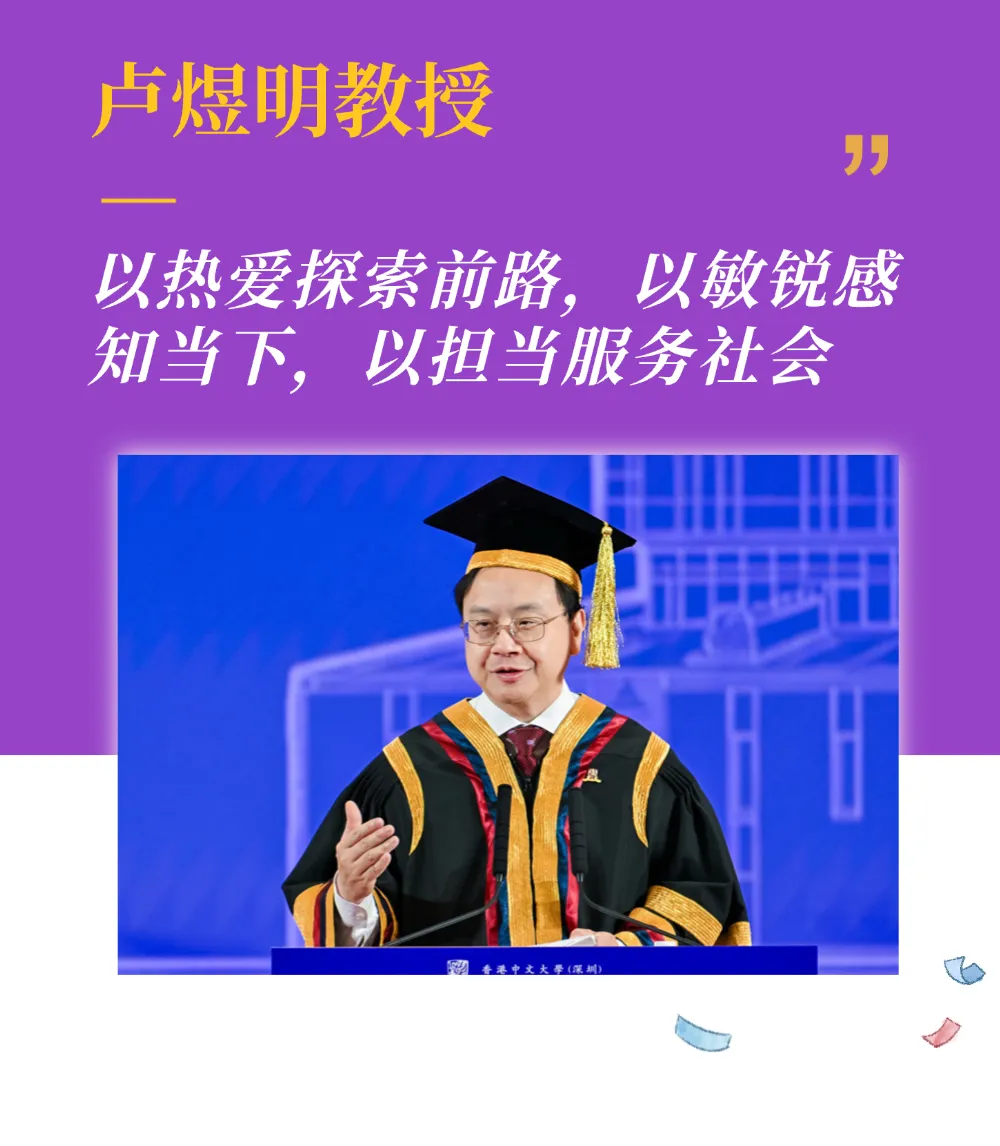
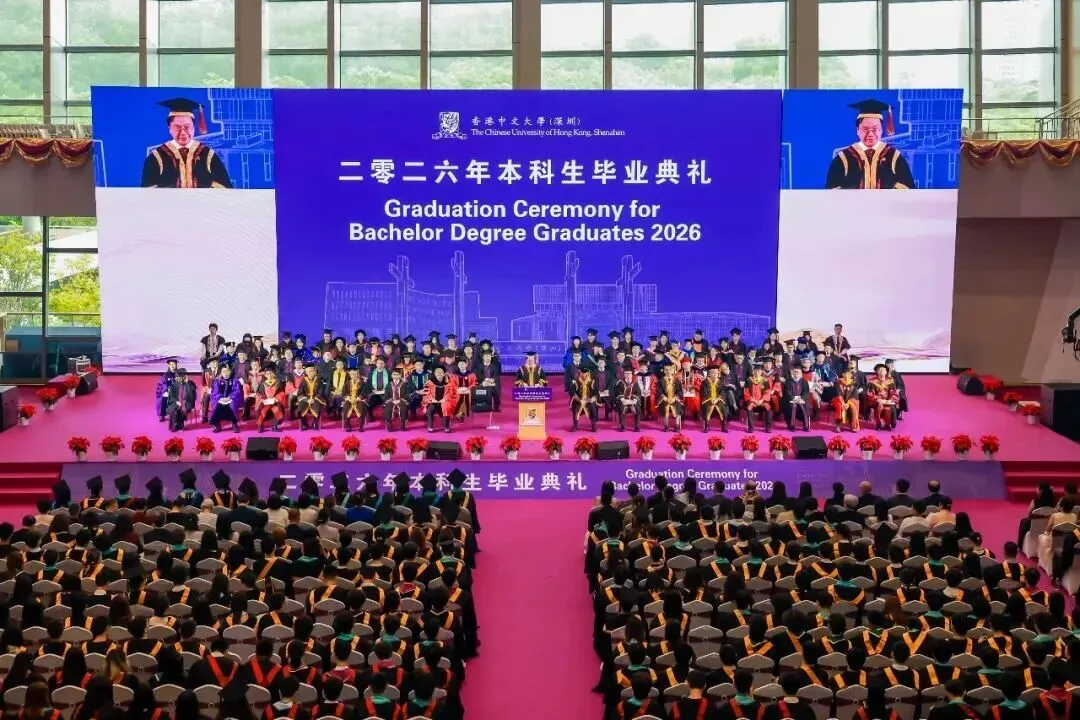
Prof. Xu, Mr. Huang, dear colleagues, families and friends, and most importantly, the Class of 2026: Good morning!
It gives me great pleasure to celebrate this important milestone with you today. This is a day for harvesting success, but I know that it has taken tremendous hard work and hard-won struggles for you to arrive at this moment. By our count, more than 1,600 students are graduating this year. Each of you has your own unique journey, and together, you form a remarkable cohort. Your achievements are also a tribute to the generous love and support of your teachers, families, and friends. You must pause to savour this moment with them. Congratulations!
Now, after graduation, some of you may pursue a higher degree, whereas others may commit yourselves to a career or entrepreneurial endeavours. Whichever path you are about to take, keep exploring your true passion in life. It may take a long time for most people to realise to which career they should devote themselves to; sometimes, it even takes a lifetime! The truth is, only a lucky few succeed in discovering a true calling in their youthful years. Well, exploration is not a bad thing, for it opens us up to more knowledge about the world and, of course, ourselves. Yet I believe that there are a few things that can help to make this exploration more fruitful.
Now, some of you may be aware that one of my main research interests is in the development of genetic tests, namely, tests especially for the fetus. It is a technology that uses cell-free fetal DNA that a baby has released into the blood of a mother to make fetal testing safer and more accurate. Now, in many interviews, I was asked why this particular area appealed to me and what made it my life mission. Looking back, actually, I can see two critical factors that enabled me to discover my lifelong passion: an understanding of the clinical needs and access to resources that empower my work.
For example, during my years as a medical student, I studied many different subjects, and one of which was obstetrics. So I became aware of the challenges and limitations of the testing methods, which could be dangerous in those days. And I vividly remember a lecture by a renowned professor called Sir John Bell in Oxford, where I learned about a then-new DNA technique called the polymerase chain reaction, or PCR, which is a method that can amplify DNA. Now, I remember this teacher telling me that this method was going to change the world, and so I believed him. And actually, after this lecture, I went up to him and he taught me this method. So now, armed with this—almost like a new toy—I was eager to explore what I could do with it. With the understanding of the important unaddressed needs in obstetrics, I thought that I could use this new technique to try to detect a baby's DNA in the mother's blood. And so that marked the beginning of a lifelong pursuit. And the test is now actually used all over the world, in over 100 countries, by hundreds of millions of pregnant women worldwide.
Now, I'm sharing this story to highlight one point. And that is, in exploring your mission, first of all, you need to understand unmet needs in your field. Gain a genuine understanding of the gaps and challenges that our society is facing. Get to the core of the problem and start digging into unfamiliar and even the hardest parts. And then, place yourself in an environment that enables you to address that problem. It may mean gaining access to resources, mentorship, collaboration, equipment, and facilities. Now, instead of opting for what will bring immediate rewards, or what seems to promise fame and stability, spend your precious youthful years on explorations that connect your talents with world issues and the well-being of humanity. This helps to give your life breadth and lasting value. So remember, many problems are unsolved not because they are easy, but because they are hard.
The second point I want to share with you is to stay attuned to life. Now, whether you are a researcher, a working professional, an artist, a teacher, or an entrepreneur, you often need to break the habitual thinking and to gain inspiration from outside. Now, life itself is an inexhaustible source of inspiration. Many of the important breakthroughs, for example in my career, are fueled by signals from life.
For example, I remember when my team was trying to piece together the fetal genome from the mother's blood. I was dreaming about maybe I could invent a magical formula, just one formula that would solve it. But I had been working on this for years and I couldn't find one formula. Eventually, I remember one day I actually went to see a movie; it was actually a Harry Potter movie. And I remember in the movie, when it started, the Harry Potter sign flew towards me—"Harry" or "H". Then, the "H" has two strokes. And when I looked at the two strokes, I thought, "How about maybe I need two formulas instead of one?" And in the end, within 10 minutes, I solved the problem. So my story is just one example of what we can learn from life, provided that we pay attention.
Now, we must learn to pay heed to seemingly small things in our day-to-day life, especially those from outside our specialized fields. This is particularly important in this age of AI. So remember, algorithms can never replace firsthand personal observation and participation. So stay grounded in real life and be attentive to every living moment. Don't be afraid to open yourself to different experiences. Very often, significant breakthroughs are made when we can suddenly identify linkages between seemingly unconnected areas.
Now, the fact that you are all sitting here today, earning a degree from one of our country's finest and youngest universities, is partly due to your own effort and partly due to the privileges that you have received. The privilege of being raised by parents who value learning. The privilege of having access to abundant learning resources and opportunities. As you navigate your career path, extend a hand to people who are less fortunate than yourself. The goal of higher education is not to widen the gaps between individuals, but to close them, or at least to narrow them. Then we can go beyond ourselves, beyond self-realization, we can bring out the best in ourselves, and sometimes the best in others as well.
Now, I hope that you will all eventually discover your true calling, even if it takes time. And I hope that you will find a career that genuinely fulfills you. May life continue to nourish and inspire your creativity and growth. When you feel prompted to do something about a problem that is seemingly hard at first, or that seemingly will take many years to solve, don't hold back. Let your knowledge and talent drive positive change in society. And let your kindness and generosity make life better for others. I have great faith in you. Congratulations, Class of 2026.