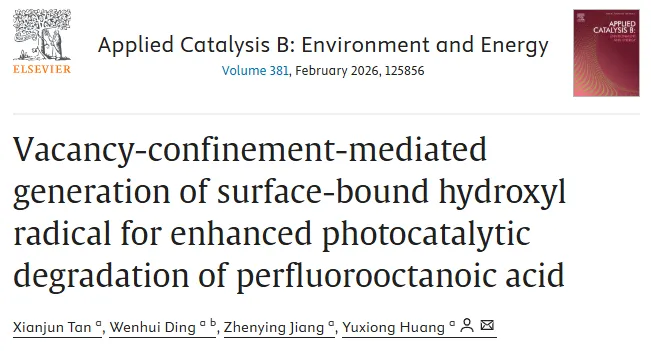
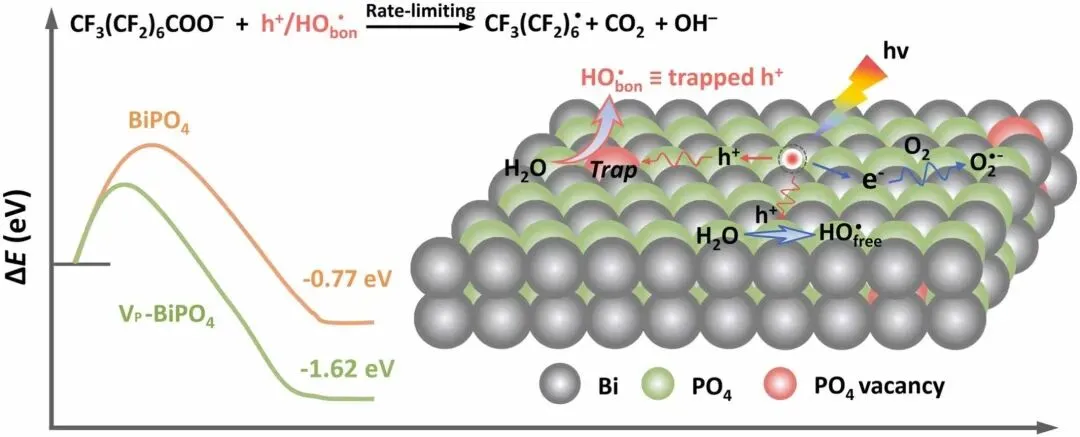
具体而言,选取BiPO4作为模型催化剂,因其具有适宜的能带排列以促进H₂O氧化反应,且对PFOA展现出优异的降解能力[22]。通过空位禁闭工程,含磷酸盐空位的BiPO4催化剂(标记为VP-BiPO4)在PFOA降解动力学方面较原始BiPO4提升了4.1倍。我们进一步揭示,PO₄空位可促进电荷分离效率,并实现光生h⁺向表面结合HO·的定向转化,赋予VP-BiPO₄催化剂卓越的PFOA降解性能(100分钟内去除率>99%)及循环稳定性(8次循环后效率>90%)。总体而言,我们的空位禁闭策略为催化活性物种的工程化设计提供了通用方法,为定向高效的光催化应用开辟了新途径。
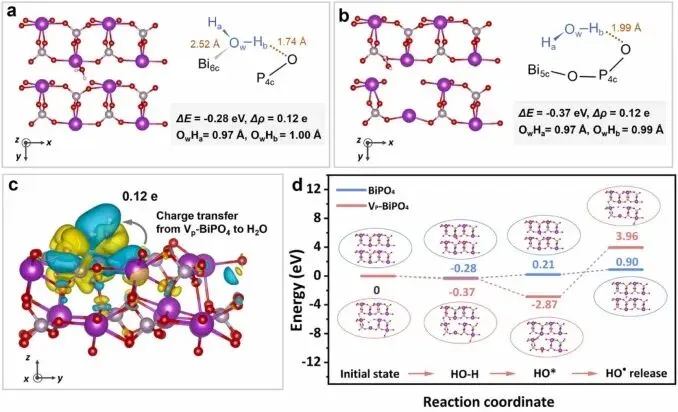
Fig. 1. Theoretical calculation of water adsorption and conversion on the BiPO4 (001) surface. (a) Adsorption of H2O on BiPO4 (001) surface. (b) Adsorption of H2O on the VP-BiPO4 (001) surface and (c) the corresponding charge density difference. The yellow and blue isosurfaces represent charge accumulation and depletion in space, respectively. (d) Calculated Gibbs free-energy profiles for H2O oxidation to HO• on BiPO4 and VP-BiPO4.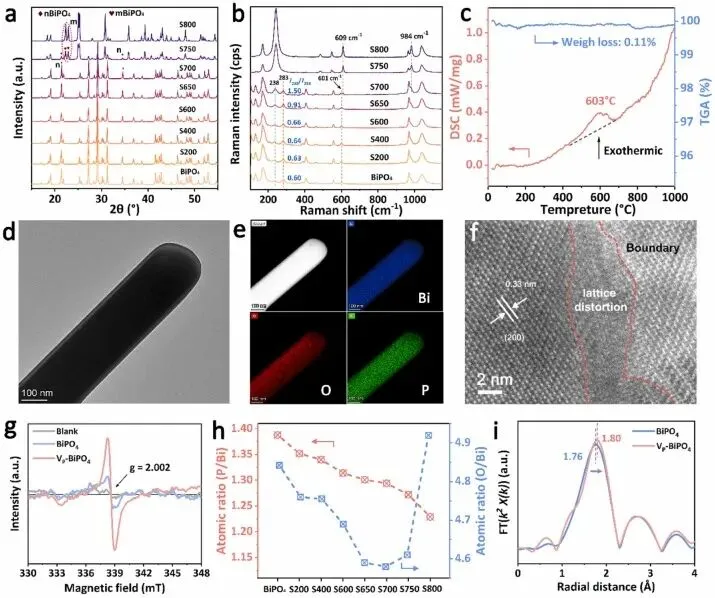
Fig. 2. Structural and defect characterization of VP-BiPO4. (a) XRD patterns and (b) Raman spectra of pristine BiPO4 and the samples calcined at different temperatures. (c) TG-DSC analysis of pristine BiPO4. (d) STEM image, (e) corresponding elemental mappings and (f) HRTEM image of VP-BiPO4 sample. (g) EPR spectra of BiPO4 and VP-BiPO4. (h) Atom ratios of P/Bi and O/Bi of different samples by XPS analysis. (i) FT-EXAFS spectra of BiPO4 and VP-BiPO4.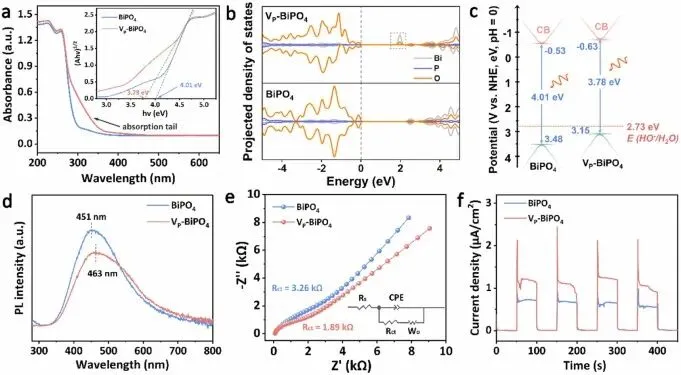
Fig. 3. Energy band and electrochemical analysis of BiPO4 and VP-BiPO4. (a) DRS, (b) PDOS, (c) energy band, (d) PL, (e) EIS and (f) I–t curves of BiPO4 and VP-BiPO4.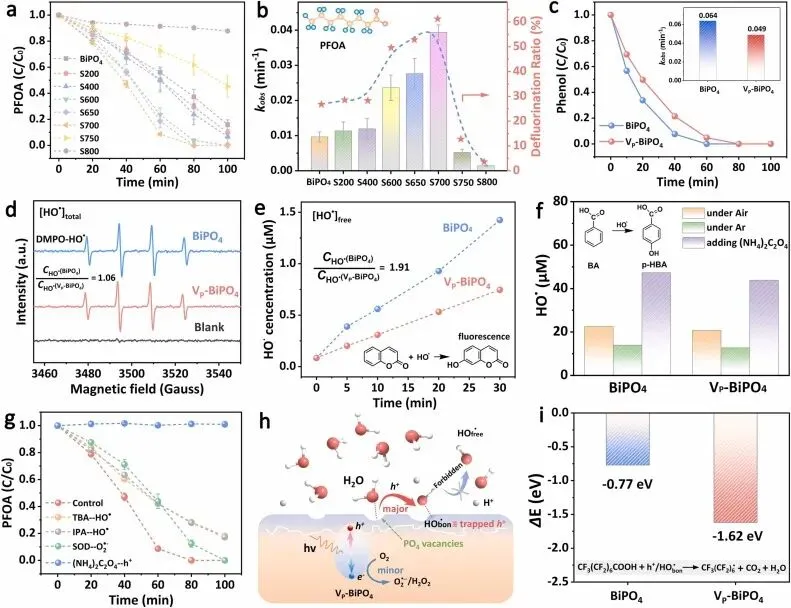
Fig. 4. Mechanistic investigation of PFOA degradation and HO• generation over BiPO4 and VP-BiPO4. (a) Photocatalytic degradation of PFOA and (b) corresponding kinetics constants and defluorination ratio over different catalysts in batch experiments. (c) Photodegradation performance of phenol by BiPO4 and VP-BiPO4 in batch experiments. (d) EPR spectra of BiPO4 and VP-BiPO4 tested in the presence of DMPO. (e) Time-dependent production of free HO• using coumarin (1 mM) as a probe. (f) Quantitative analysis of produced HO• using BA probe (1 mM). (g) Photocatalytic degradation of PFOA by VP-BiPO4 in the presence of different sacrificial trapping agents. (h) Schematic illustration of the conversion mechanism for photogenerated holes to HO• over BiPO4 and VP-BiPO4 photocatalysts. (i) Calculated Gibbs free-energy of the photoexcited hole-dominated step in PFOA degradation by BiPO4 and VP-BiPO4.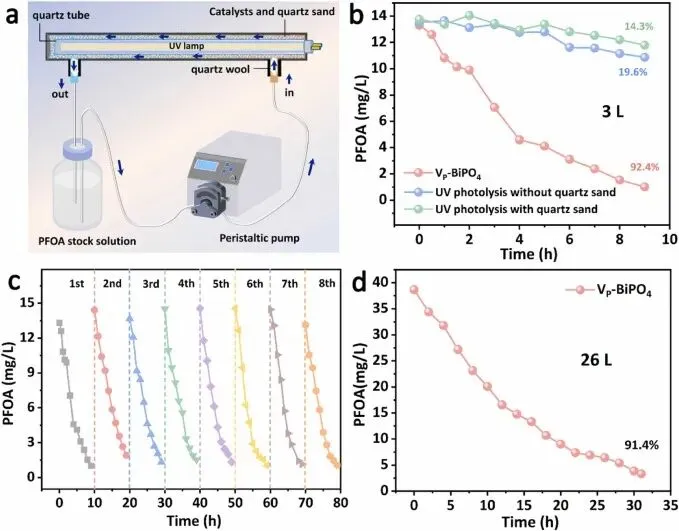
Fig. 5. (a) Schematic illustration of the continuous-flow platform. (b) PFOA degradation in continuous-flow devices by VP-BiPO4 and UV photolysis with/without quartz sand. (c) Cyclability experiments by VP-BiPO4. (d) Scale-up experiment by VP-BiPO4 photocatalysts. [Experimental conditions: Light source, 254 nm, 40 W or 75 W; flow rate, 20 mL/min; catalyst dosage, 14 g cat. mixed with 2.65 kg fused silica sand.].全氟烷基物质(PFAS)因其广泛应用、环境持久性和严重健康影响而被称为“永不分解的化学物质”,引发全球关注。PFAS在环境中的普遍存在促使研究人员开发高效且经济实惠的技术,以从各种水基质中去除这些物质。异相光催化作为一种光驱动且环保的技术,被视为PFAS修复的潜在解决方案。然而,其活性物种难以控制的问题限制了实际应用。本研究基于理论计算指导,通过热诱导相变成功合成了富含空位缺陷的VP-BiPO₄光催化剂。该缺陷调控催化剂展现出卓越的PFOA降解效率(>99%)与同步脱氟能力(氟离子回收率70.1%),其降解动力学性能较原始BiPO₄提升4.1倍。机理研究揭示:空位限制介导的活性物种生成路径调控——尤其是表面结合HO·的优先形成——是催化性能提升的关键。该催化剂经八次连续循环仍保持90%以上降解效率,兼具结构稳健性与实用性。该缺陷工程策略有望推广至其他难降解化合物的环境净化领域,推动新一代高性能光催化剂在可持续水处理中的发展。未来研究应重点考察催化剂光学特性(如吸收系数与散射系数)及反应器光学厚度对光催化性能的影响,这将深化对内在光催化动力学机制的理解。
文献信息
Xianjun Tan, Wenhui Ding, Zhenying Jiang, Yuxiong Huang, Vacancy-confinement-mediated generation of surface-bound hydroxyl radical for enhanced photocatalytic degradation of perfluorooctanoic acid, Applied Catalysis B: Environment and Energy, 2026, https://doi.org/10.1016/j.apcatb.2025.125856
关注环材有料视频号,提供会议、讲座等直播服务!
微信加群:
环材有料为广大环境材料开发研究领域的专家学者、研发人员提供信息交流分享平台,我们组建了环境材料热点领域的专业交流群,欢迎广大学者和硕博学生加入。

进群方式:扫下方二维码添加小编为好友,邀请入群。请备注:名字-单位-研究方向。
扫二维码添加小编微信,邀请入群,获得更多资讯