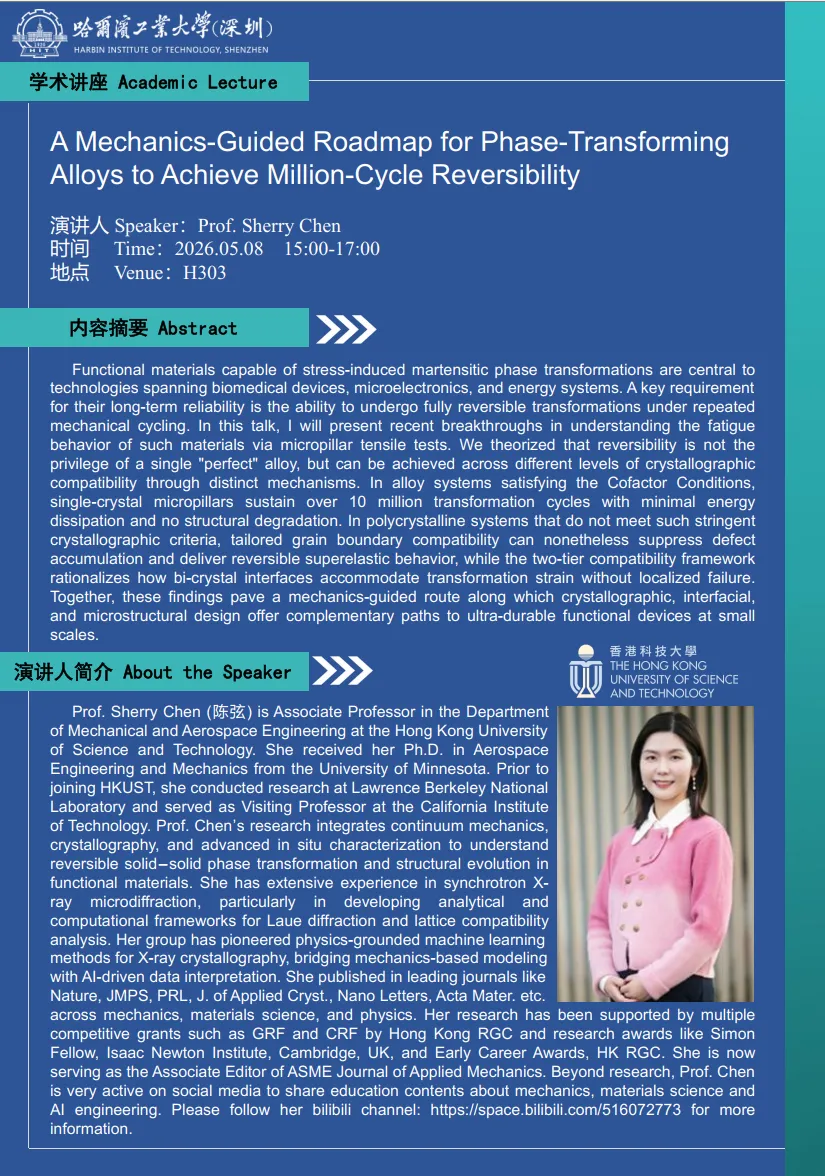
主题/TOPIC:A Mechanics-Guided Roadmap for Phase-Transforming Alloys to Achieve Million-Cycle Reversibility
时间/DATE&TIME:2026年5月8日(星期五) 15:00-17:00
地点/LOCATION:H303
报告人/SPEAKER:陈弦
陈弦,香港科技大学机械与航空航天工程系副教授。她在明尼苏达大学获得航空航天工程与力学博士学位,加入香港科技大学前,曾在劳伦斯伯克利国家实验室开展研究,并担任加州理工学院访问教授。她的研究结合连续介质力学、晶体学与先进原位表征,关注功能材料中的可逆固—固相变及结构演化。她在同步辐射 X 射线微衍射方面具有丰富经验,尤其致力于 Laue 衍射与晶格相容性分析的解析和计算框架开发。其团队开创了面向 X 射线晶体学的物理约束机器学习方法,将基于力学的建模与 AI 驱动的数据解释相结合。她在 Nature、JMPS、PRL、Journal of Applied Crystallography、Nano Letters、Acta Materialia 等力学、材料科学与物理领域期刊发表论文,并获得香港研究资助局 GRF、CRF 等竞争性基金支持,以及 Simon Fellow、Isaac Newton Institute、Cambridge, UK 和 HK RGC Early Career Awards 等研究奖项。目前她担任 ASME Journal of Applied Mechanics 副编辑,并积极通过社交媒体分享力学、材料科学和 AI 工程相关教育内容。摘要/ABSTRACT:Functional materials capable of stress-induced martensitic phase transformations are central to technologies spanning biomedical devices, microelectronics, and energy systems. A key requirement for their long-term reliability is the ability to undergo fully reversible transformations under repeated mechanical cycling. In this talk, Prof. Sherry Chen will present recent breakthroughs in understanding the fatigue behavior of such materials via micropillar tensile tests. The work theorizes that reversibility is not the privilege of a single “perfect” alloy, but can be achieved across different levels of crystallographic compatibility through distinct mechanisms. In alloy systems satisfying the Cofactor Conditions, single-crystal micropillars sustain over 10 million transformation cycles with minimal energy dissipation and no structural degradation. In polycrystalline systems that do not meet such stringent crystallographic criteria, tailored grain boundary compatibility can suppress defect accumulation and deliver reversible superelastic behavior, while the two-tier compatibility framework rationalizes how bi-crystal interfaces accommodate transformation strain without localized failure. Together, these findings pave a mechanics-guided route along which crystallographic, interfacial, and microstructural design offer complementary paths to ultra-durable functional devices at small scales.