The history of the Shenzhen Library is more than just a timeline of a building; it is a reflection of Shenzhen’s meteoric rise from a small fishing town to a global technological powerhouse.
深圳图书馆的历史不仅仅是一座建筑的时间线;它反映了深圳从一个小渔村迅速崛起为全球科技枢纽的历程。
Known for its commitment to "Cultural Strength," the library has evolved into one of the busiest and most technologically advanced public library systems in the world.
该图书馆以致力于“文化强市”而闻名,现已发展成为世界上最繁忙、技术最先进的公共图书馆系统之一。
Below is the chronological journey of the Shenzhen Library.
以下是深圳图书馆的发展历程。
The Early Foundations (1950s – 1980s)
早期基础 (1950s – 1980s)
The roots of the library actually precede the official founding of the Shenzhen Special Economic Zone. In 1950, a small reading room was established in Bao’an County (which would later become Shenzhen).
该图书馆的根源实际上早于深圳经济特区的正式成立。1950年,宝安县(后来的深圳)建立了一个小阅览室。
It was a modest collection meant for local residents, containing only a few thousand volumes.
那是一个为当地居民准备的简陋藏书点,仅有几千册藏书。
In 1979, as China began its "Reform and Opening-up" policy, Bao’an County was officially renamed Shenzhen City.
1979年,随着中国开始实施“改革开放”政策,宝安县正式更名为深圳市。
Recognizing that a modern city required a center for knowledge, the local government began planning a formal public library.
地方政府意识到现代城市需要一个知识中心,于是开始规划正式的公共图书馆。
On July 1, 1983, the "Shenzhen Library" was officially established, though it initially operated out of temporary facilities.
1983年7月1日,“深圳图书馆”正式成立,尽管最初是在临时设施中运营。
The First Landmark (1986 – 2005)
第一座地标 (1986 – 2005)
The first major milestone occurred in 1986. The library moved into its first purpose-built home at Lychee Park (Lizhi Park).
第一个重大里程碑发生在1986年。图书馆搬进了位于荔枝公园的第一个专用馆舍。
This 13,000-square-meter facility was a source of great pride for the young city. At the time, it was considered one of the most modern libraries in Guangdong Province.
这座1.3万平方米的设施是这座年轻城市的骄傲。在当时,它被认为是广东省最现代化的图书馆之一。
Throughout the 1990s, the library became the intellectual heart of the city.
在整个20世纪90年代,图书馆成为了这座城市的智力心脏。
As migrants flocked to Shenzhen to work in its new factories and tech startups, the library provided a vital space for self-study and professional development.
随着移民涌入深圳,进入新工厂和科技初创公司工作,图书馆为自我学习和职业发展提供了重要的空间。
It was during this period that the library began its digital transition, implementing some of the earliest computerized cataloging systems in China.
正是在这一时期,图书馆开始了数字化转型,实施了中国最早的一批计算机编目系统。
The Architectural Icon at Civic Center (2006 – 2015)
市民中心的建筑图标 (2006 – 2015)
By the turn of the millennium, Shenzhen had outgrown its Lychee Park facility.
到千禧之交,深圳原有的荔枝公园馆舍已不敷使用。
The city's population was exploding, and the demand for information was higher than ever.
城市人口爆炸式增长,对信息的需求比以往任何时候都高。
To match the city’s new status as a "City of Design," the government commissioned a new flagship building in the Futian Central Business District.
为了匹配深圳作为“设计之都”的新地位,政府在福田中央商务区委托建造了一座新的旗舰建筑。
In July 2006, the new Shenzhen Library officially opened its doors at the Civic Center.
2006年7月,位于市民中心的新深圳图书馆正式开馆。
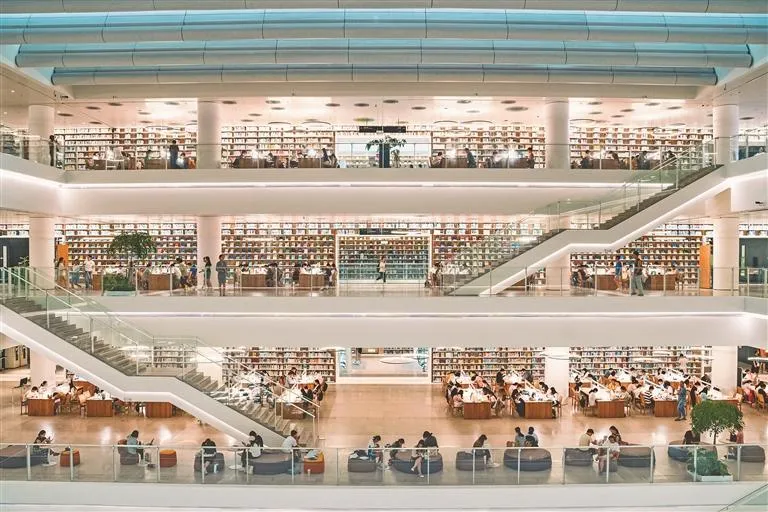
Designed by the renowned Japanese architect Arata Isozaki, the building became an instant architectural icon.
该建筑由日本著名建筑师矶崎新设计,立即成为了建筑地标。
Its striking "silver tree" columns and massive glass curtain walls symbolized the growth of knowledge and the transparency of information.
其醒目的“银树”柱体和巨大的玻璃幕墙象征着知识的增长和信息的透明。
This move wasn't just about aesthetics; it was a technological leap.
这次搬迁不仅仅是为了美观,更是一次技术跨越。
The library introduced a massive Radio Frequency Identification (RFID) system, allowing for automated book sorting and self-service kiosks.
图书馆引入了大规模的无线射频识别(RFID)系统,实现了自动分拣和自助服务终端。
This was revolutionary at the time, making the Shenzhen Library one of the first in China to allow patrons to check out and return books without interacting with staff.
这在当时是革命性的,使深圳图书馆成为中国首批允许读者在无需与工作人员互动的情况下自助借还书的图书馆之一。
The Era of the "City of Libraries" (2016 – 2022)
“图书馆之城”时代 (2016 – 2022)
In the mid-2010s, the library’s mission shifted from managing a single building to managing a massive urban network. Shenzhen set a goal to become a "City of Libraries."
在2010年代中期,图书馆的使命从管理单一建筑转向管理庞大的城市网络。深圳提出了建设“图书馆之城”的目标。
Key developments during this time included:
这一时期的主要进展包括:
The 24-Hour Book Machines: Starting around 2008 and peaking in the 2010s, the library deployed hundreds of "Atmosphere Library" machines across the city—essentially vending machines for books—allowing citizens to borrow and return items in residential areas and subway stations.
24小时自助借还机:从2008年左右开始,并在2010年代达到高峰,图书馆在全市部署了数百台“城市街区自助图书馆”——本质上是书籍自动售货机——允许市民在社区和地铁站借还书。
Unified Service: The library spearheaded the "Unified Library Service System of Shenzhen," which linked the main library with district and community libraries. This meant a reader could borrow a book in Futian and return it in Nanshan.
统一服务:图书馆牵头建立了“深圳市图书馆联合服务体系”,将主馆与各区馆、社区馆联网。这意味着读者可以在福田借书,在南山还书。
Digital Transformation: The library launched a robust mobile app and digital archive, providing free access to millions of e-books, academic journals, and historical documents to anyone with a Shenzhen library card.
数字化转型:图书馆推出了功能强大的移动应用和数字档案库,为任何持有深圳图书馆证的人提供数百万本电子书、学术期刊和历史文献的免费访问权限。
By 2018, the Shenzhen Library was consistently ranked as one of the most visited libraries in China, often seeing over 10,000 visitors a day on weekends.
到2018年,深圳图书馆稳居中国访问量最大的图书馆之列,周末的日访问量经常超过1万人次。
The New North Main Library (2023 – Present)
新的北馆 (2023 – 至今)
The most recent chapter in the library’s history began in late 2023 with the opening of the Shenzhen Library North, located in the Longhua District.
图书馆历史的最新篇章始于2023年底,位于龙华区的深圳图书馆北馆正式开放。
This new facility is a massive expansion, acting as both a public reading space and the central "brain" for the city's book collection.
这座新设施是一次大规模扩张,既是公共阅读空间,也是全市藏书的中央“大脑”。
It features an incredibly advanced Automated Storage and Retrieval System (ASRS).
它配备了极其先进的自动仓储确认系统(ASRS)。
Beneath the library floors lies a massive underground "smart warehouse" where robots retrieve books from high-density shelves and deliver them to the surface via elevators.
在图书馆楼层下方是一个巨大的地下“智能书库”,机器人从高密度书架上取书,并通过电梯将其送至地面。
This system allows the library to house millions of additional volumes while keeping the public floors open and spacious for readers.
该系统使图书馆能够容纳数百万册额外藏书,同时保持公共楼层对读者的开放和宽敞。
Today, the Shenzhen Library stands as a dual-core system: the iconic Futian branch remains the cultural heart of the city center, while the North branch serves as the technological and archival hub.
如今,深圳图书馆呈现出双核体系:标志性的福田总馆依然是市中心的文化心脏,而北馆则作为技术和档案枢纽。
Legacy and Impact
遗产与影响
From its humble beginnings as a small county reading room to a world-class institution with robotic archives, the Shenzhen Library has proved that even in a city built on commerce and high-tech manufacturing, books remain the foundation of progress.
从最初简陋的县城阅览室到拥有机器人档案库的世界级机构,深圳图书馆证明了即使在以商业和高科技制造业为基础的城市中,书籍依然是进步的基石。
It currently serves as the center of a network comprising over 700 public library branches and hundreds of self-service points, ensuring that no citizen is ever more than a short walk away from a book.
它目前作为一个拥有700多个公共图书馆分馆和数百个自助服务点的网络中心,确保每位市民步行不远即可触及书籍。
For more insightful content, long press the QR code to follow