2026年深圳市高三年级第一次调研考试 英语试卷 答案 简析+详析 2026.03.05
2026年深圳市高三年级第一次调研考试
英 语2026.3
温馨提示:学研资料,方便学研,转载注明,勿商用!
研习者按:多维语篇中考查思维品质和应用能力试卷整体呈现出“重素养、考应用”的特点,尤其在语篇选材上深度融合了中国文化与前沿科技,要求学生具备扎实的语言基础和灵活的语境迁移能力
试卷共8页, 卷面满分120分, 折算成130分计入总分。考试用时120分钟。
注意事项:
1.答卷前,考生务必用黑色字迹钢笔或签字笔将自己的姓名、班级、准考证号填写在答题卡上。用 2B铅笔将试卷类型(A)填涂在答题卡相应位置上。将条形码横贴在答题卡右上角“条形码粘贴处”。
2.作答选择题时,选出每小题答案后, 用 2B铅笔把答题卡上对应题目选项的答案信息点涂黑; 如需改动,用橡皮擦干净后,再选涂其他答案,答案不能答在试卷上。
3.非选择题必须用黑色字迹钢笔或签字笔作答, 答案必须写在答题卡各题目指定区域内相应位置上; 如需改动, 先划掉原来的答案,然后再写上新的答案; 不准使用铅笔和涂改液。不按以上要求作答的答案无效。
4.考生必须保持答题卡的整洁。考试结束后,留存试卷,交回答题卡。
第二部分阅读(共两节,满分50分)
第一节(共15小题; 每小题2.5分, 满分37.5分)
阅读下列短文,从每题所给的A、B、C、D四个选项中选出最佳选项。
A
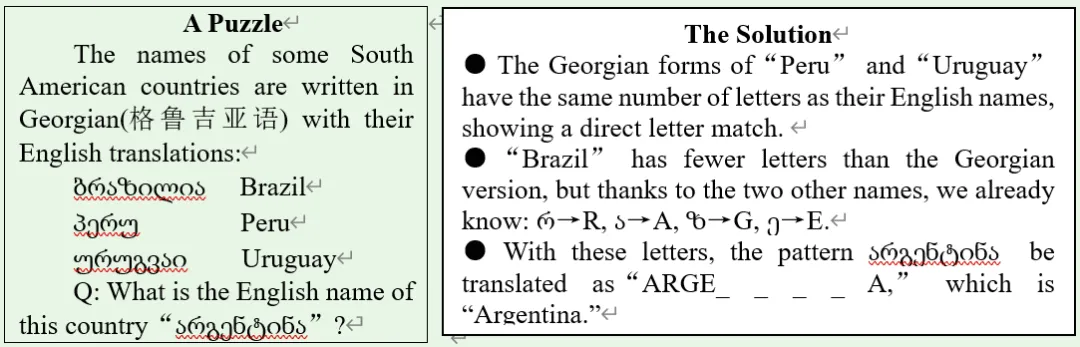
 The International Linguistics Olympiad(IOL) is acompetition for pre-university students, held in a different country each yearsince 2003. It challenges participants, both individually and in teams, tosolve linguistic(语言学的) puzzles. To compete at the IOL, no specialknowledge is required, only basic language concepts, logic, patience, andcreative thinking. Try this beginner sample to see if the IOL is right for you.
 Contest Rules
• Each individual contestant or team must choose a working language fortheir problems and solutions, a choice that cannot be changed less than twoweeks before the Olympiad begins.
• The individual contest involves solving five problems in six hours,whereas the team contest features one problem with two hours less.
• Unless instructed, giving multiple answers will receive zero marks.Besides, a detailed explanation is required for each answer; failure to provideone will result in a lower score.
Awards
The team contest will award up to one gold, twosilver, and three bronze medals. In the individual contest, the number of gold,silver, and bronze medals awarded shall be in theratio 1:2:3, with the total number of medals being between one quarterand one third of the contestants. Click here to find out other awards.
21.Whichis essential to solve the sample puzzle?
A. Linguistic fluency.B. Reasoning ability.
C. Geographic knowledge.D. Mathematical calculation.
22.Whatis different about the rules for the individual and team contest?
A. The duration of the competition.B. The deadline for language choice.
C. The result of giving multiple answers.D. The requirement for answer explanations.
23.Ifthere are 240 individual contestants, how many medals could be awarded intotal?
A.40.B.54.C.72.D.84.
B
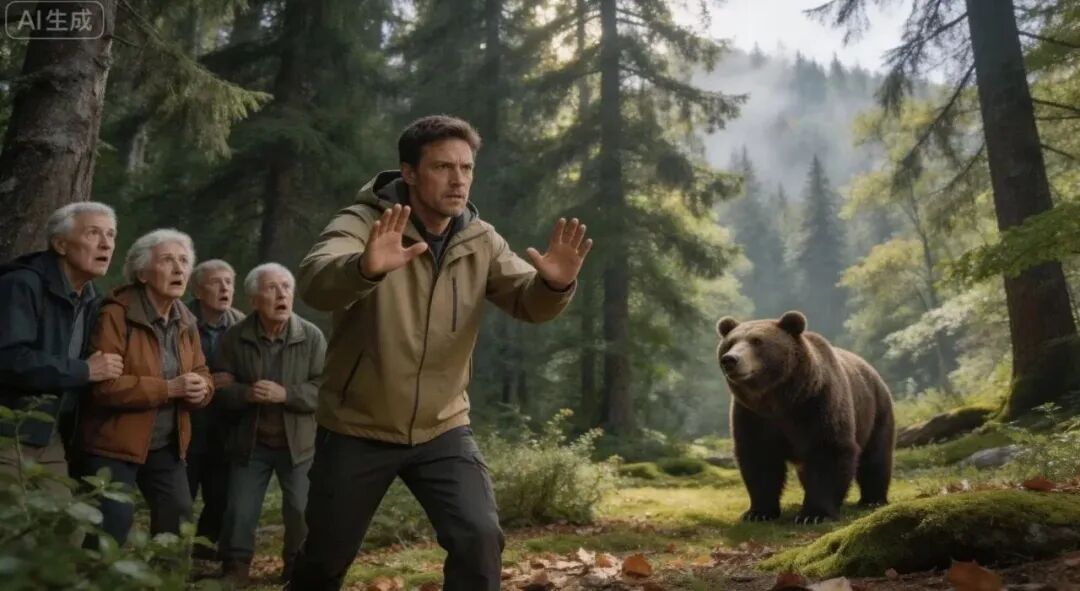 This summer I came face-to-face with threedeep-rooted fears: heights, bears, and ageing.
Two friends joined me on a four-day wildernessgetaway, and since we were all in our seventies, we decided we'd better gowhile we still could. Our adventure began with a scary drive up a windingmountain road.
On one hike, I found myself hanging onto a wire ona bridge made of two partly rotten(腐烂的)logs, suspended high above rushing rapids. I wouldnever have attempted it without our guide ahead, mouthing encouraging words.Fixing my eyes on her boots, I inched along the shaky logs. Somehow, I made itacross, flooded with a rush of intense excitement and huge relief.
Later, after spotting bear tracks, we were told tomake loud noises, which soon became a game once the tension faded.
Until suddenly, time stood still.
We had just crossed a stream when the guidewhispered, “There’s a bear.” I looked up in disbelief and saw not one, but two,about ten meters above us-the brown mother in front, her cub behind.
Though scared speechless, I couldn’t help noticinghow beautiful they looked in their natural setting. I wondered if it would bemy last memory. As they started towards us, we recovered enough to shout andwave our hiking poles. Taken aback, they stopped, and then slowly turned away.Another fear was overcome!
On our final morning, after a quiet, thoughtfulwalk through the forest, we were asked to bring back a“meaningful” stick, rock,and leaf to share what would “stick” with us, what “rocked,” and what we would “leaf”behind. The bond of friendship would stick with me. Women supporting oneanother truly rocked. And I hoped to leave some fears behind.
Our guide ended by expressing her admiration,praising not only our fitness but also our positive attitude, and saying shehoped to be like us in another thirty or forty years. Those unexpected wordswarmed my heart and eased my fear of being “over the hill.” Being valuedfor what we had accomplished felt like winning an Olympic medal—even if justfor participation.
24.Howdid the author cross the bridge?
A. By taking mindful steps.B. By rushing across it bravely.
C. By using her sense of direction.D. By having the guide drag her over.
25.Whydid the bears leave?
A. They were attracted by the natural setting.
B. They were afraid of the noise of the rapids.
C. They were surprised at the group's actions.
D. They were threatened by the guide's rocks.
26.Whydid the guide ask them for a stick, rock, and leaf?
A. To pick up some souvenirs.B. To reflect on the journey.
C. To symbolize their teamwork.D. To check their observationskills.
27. Whatdoes the underlined phrase “over the hill” in the last paragraph mean?
A. Past the peak of youth.B. Too high to go down.
C. Out of place in society.D. Beyond physical limits.
C
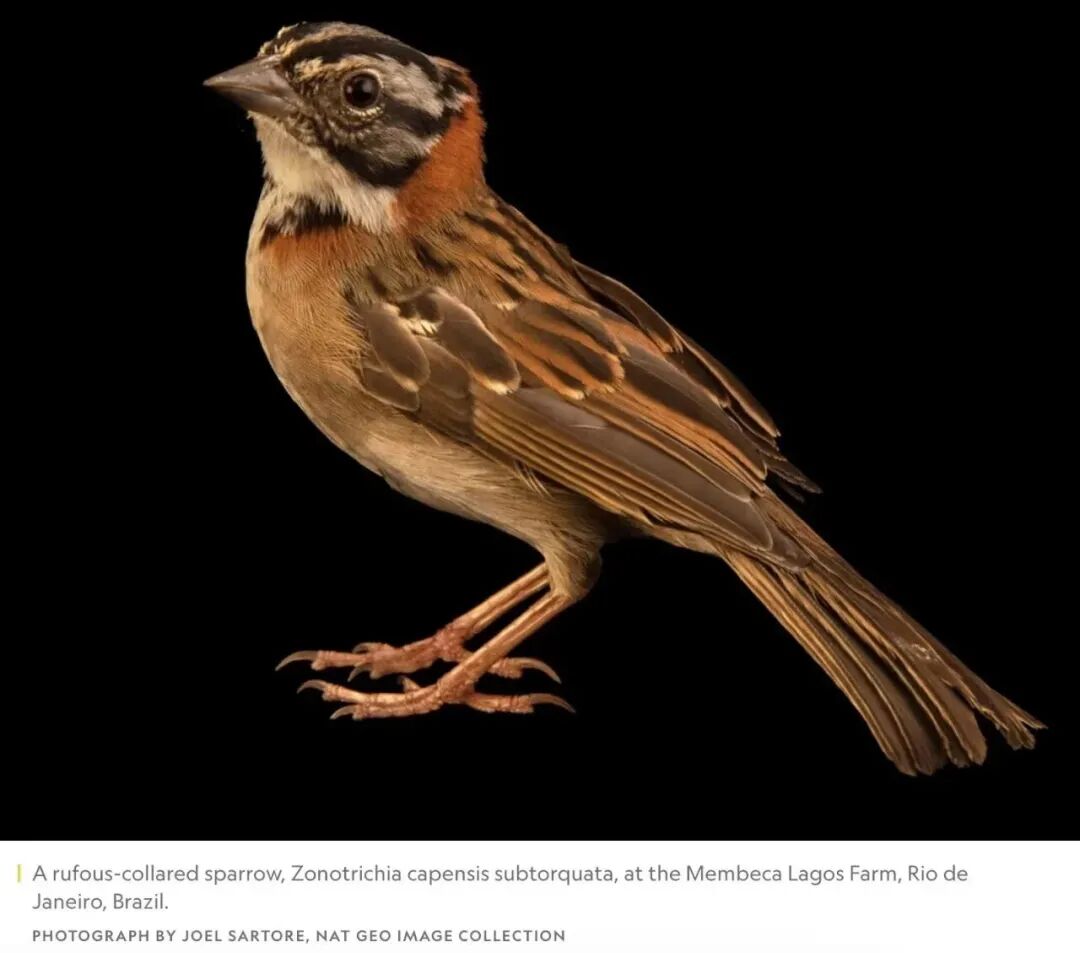 Researchers from the University of Buenos Aireshave successfully used a robotic tutor to teach the male chingolo, akind of small bird in South America, a song that was once part of the species’culture but had been lost for more than half a century.
Male chingolos learn their unique,two-second melody from adult males.“It is a distinctive song—like afingerprint, but learned,” says one of the researchers. “It serves to attractfemales and protect territory. It is the bird's way of saying,‘This is me, andhere I am.’” However, urbanization and habitat loss have broken this learningchain, causing local song “dialects” to disappear.
Driven by this problem, researchers took on apioneering task: bringing back a song that had disappeared from the wild—knownonly from a musical record made in the 1960s—to a population of chingolos.
Using physics-based modeling of the bird’s vocaltract(声道), the team first created an accurate artificialversion of the lost song. They then engineered this model into a physicaldevice designed to broadcast the forgotten melody—a “robotic tutor.” Thisartificial song was introduced to the chingolos in the park during theircritical learning period from October to February. The sessions took placeduring peak singing hours and were limited to a maximum of eight hours. Therewere random pauses(停顿) in between so that the birds interpreted theplayback from the three devices placed in the area as a real exchange, as ifthese devices were responding to each other. This stimulated the birds’ vocalresponses.
The results were impressive. Young chingoloslearned and adopted the song, though they added their own population’s “accent”to the final trill(颤音), which showed that their singing is shaped bylearned behaviors and inborn characteristics.
“This is about preserving not just genetic, butcultural biodiversity,” says another researcher. The team is now developing AIsystems to automatically identify individual bird songs and planning to studycultural spread in bird populations to ensure that bird culture is not lostagain.
28.Whydid the researchers teach the birds the song?
A. To save an endangered species.B. To bring back a lostcultural element.
C. To develop new robotic devices.D. To prove birds' ability tolearn.
29.Whatis a role of chingolos’ song?
A. It keeps hunters away from them.B. It helps them adapt to urbangrowth.
C. It functions as their social identity.D. It increases their chance ofsurvival.
30.Whatis the purpose of the random pauses?
A. To protect the birds’ vocal tract.B. To test the birds’reaction speed.
C. To push the birds to catch the beat.D. To trick the birds intointeraction.
31.Whatcan we learn from chingolos’ learning results?
A. The song has spread to other bird species.
B. Their singing shows special vocal features.
C. Their response to the song needs improving.
D. The effectiveness depends on their population.
D
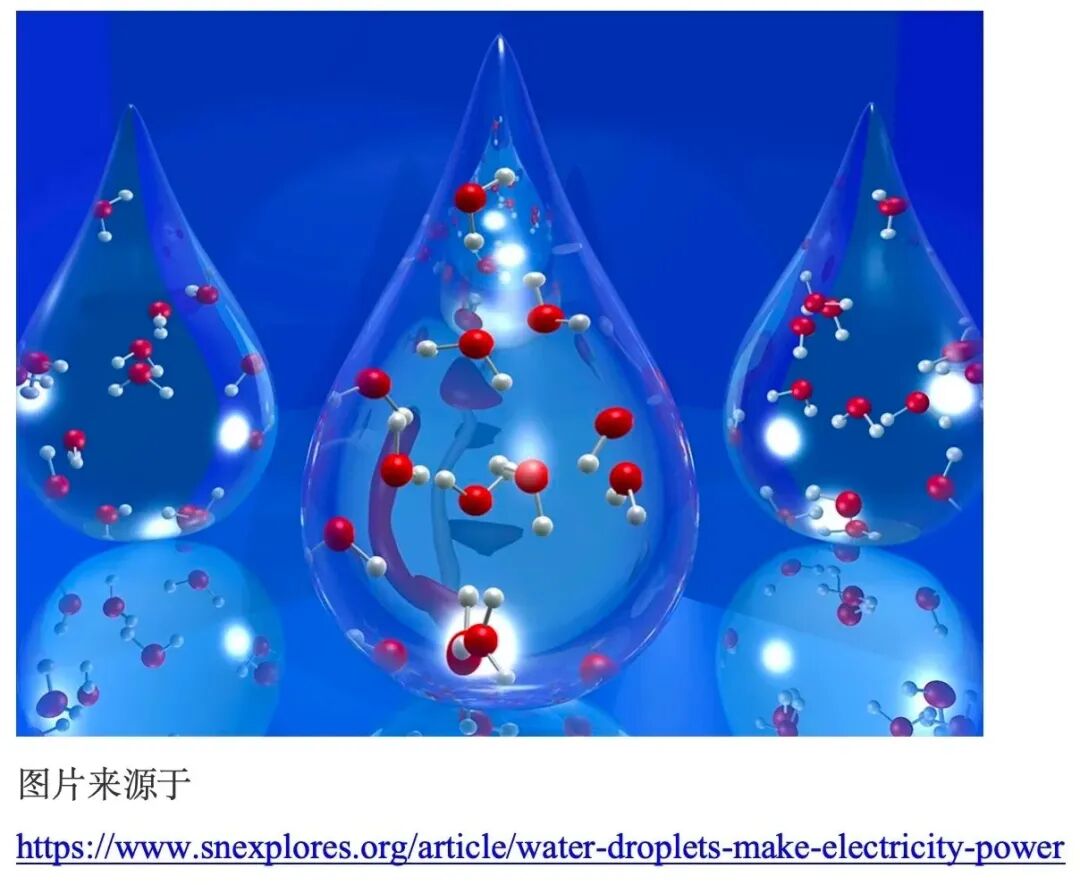 When you rub(摩擦) a balloon on your skin, it produces electricity—afamiliar example of charge separation(电荷分离), a process in which opposite charges areseparated, creating electric potential. Similarly, raindrops striking a narrowtube create a tiny yet significant burst of energy. Now, researchers from theNational University of Singapore (NUS) have tapped into this effect to generateelectricity using rain-like droplets.
Conventional hydropower(水力发电) relies on large water flows, which only work in places like rivers. Forsmaller, slower flows, researchers have explored charge separation. They use atube to let water flow through it continuously. Charges gather on the surfacethat the water touches. In this way, researchers can collect charges, but it isfar from effective.
To solve this problem, the NUS team built a specialdevice. At both ends of the device—the top of the newly-designed tube(about 2millimeters in width), and the water-collecting cup at the bottom—electricalwires were placed to harvest charges. First, water is released from a metalneedle, forming rain-like droplets. When these droplets enter the tube, theirimpacts create “plug flow,” in which the water forms mini columns separated byair gaps. This flow is crucial because it allows more surface contact and moretime for charges to build up, generating up to 100,000 times more chargeseparation than continuous flow. As charged droplets exit the tube and fallinto the cup, charges build up in the water, creating an electric current. Intests, four tubes produced enough electricity to power 12 LED lightscontinuously for 20 seconds.
According to the study’s lead author, this modelshows how rain can be used to generate clean electricity effectively andsustainably, especially in rainy places such as Singapore. Its potential isenormous, as it offers an alternative energy source even in cities. Imagine a raincollection device on your roof, producing small amounts of electricity wheneverit rains—a small step for a raindrop, but a giant leap for sustainable energytechnology.
32.Whatproblem do the NUS researchers aim to solve?
A. The difficulty of separating charges.B. The lack of clean electricitysources.
C. The inefficiency of charge harvesting.D. The damage of traditionalhydropower.
33.Whichof the following best illustrates “plug flow”?
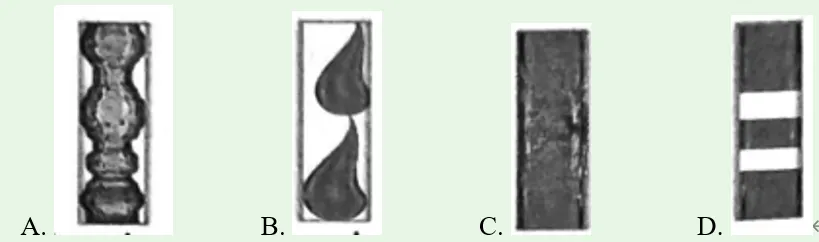 34.Whatis the last paragraph mainly about concerning the model?
A. Its potential cost in urban areas.B. Its promising future for practicaluse.
C. Its complex design for rain power.D. Its limitations in rainy environments.
35.Whatis a suitable title for the text?
A. Revolutionary Energy from Raindrops
B. Urgent Demand for Sustainable Energy
C. Capturing Raindrops through Innovation
D. Turning Charge Separation into Electricity
第二节(共5小题; 每小题2.5分,满分12.5分)
阅读下面短文,从短文后的选项中选出可以填入空白处的最佳选项。选项中有两项为多余选项。
 I put on a headset, and within seconds I amsomewhere else. Ice sheets float on dark water. Wind brushes past my ears,sharp and restless. In the distance, mountains glow(发光) under the moonlight. Moments later, I find myself inside a museum,leaning close to a painting I have never seen in real life.36 This is the promise of virtual reality(VR): a world delivered to us without leaving home.
There is much to appreciate in this form of travel.37 There is no need to consider weatherconditions, health issues or financial pressure. You may enter distant placesat any moment and leave just as freely. For those restricted by schedule,health, or income, VR quietly removes barriers that traditional travel oftensets in place.
38 Travelerswander through unfamiliar streets, sample local dishes, and engage face-to-facewith people shaped by different traditions. Such encounters awaken the sensesand create lasting memories. More importantly, they change how places feel tous, not just how we understand them.
This distinction is clear, because learning about adestination is not the same as being there. Virtual travel offers designedscenes and programmed sensations, but it remains carefully controlled. Realtravel, by contrast, is shaped by unpredictability. 39 In those unplanned moments, understandingbecomes lived rather than recorded.
Virtual reality will undoubtedly continue toevolve, enriching how we preview journeys and imagine distant worlds. Still, itcannot replace actual presence. Travel is not simply about seeing farther; itis also about feeling where you stand. 40
A. I am not moving, yet I am traveling.
B. Yet real travel leaves a deeper mark.
C. My feet ache as my journey stretches across theday.
D. Virtual journeys are convenient, time-saving,and widely accessible.
E. Some knowledge, it seems, only arrives when yourfeet are on the ground.
F. It demands choices, adaptation, and constantawareness of the unexpected.
G. But the convenience may gradually weaken ourdesire to explore the real world.
第三部分语言运用(共两节, 满分30分)
第一节(共 15小题; 每小题 1分, 满分 15分)
阅读下面短文,从每题所给的A、B、C、D四个选项中选出可以填入空白处的最佳选项。
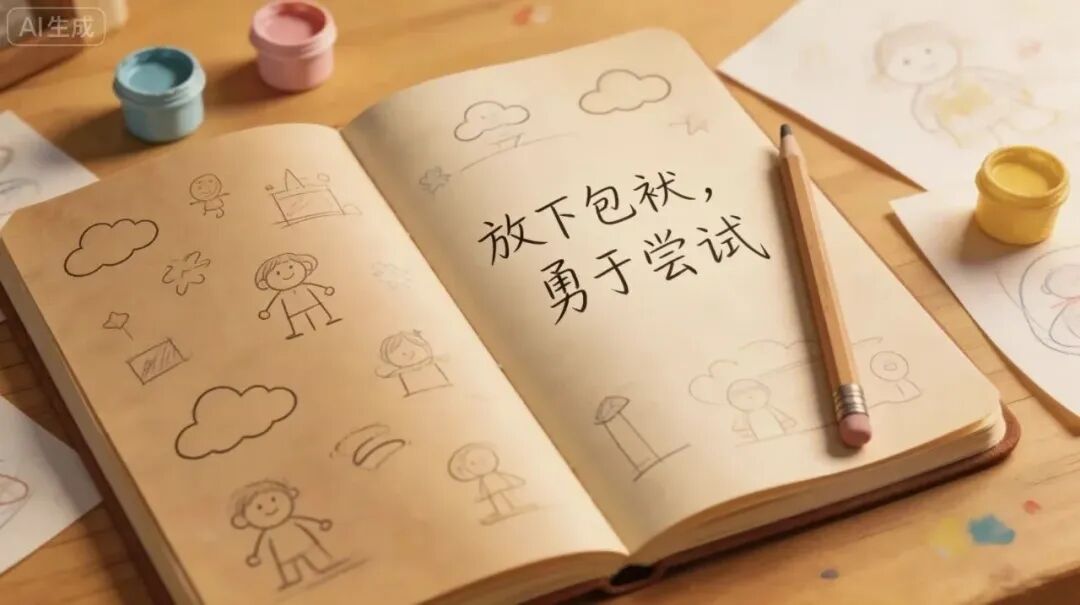 I still remember the day I bought my “nice”notebook. It was a leather-bound journalwith cream-colored pages. I was sure it would make me the type of person whojournals regularly, and who 41 beautiful thoughts. But it didn’t work.
That gorgeous notebook sat 42 for months. When I finally opened it, Ihesitated. The pages felt too delicate and too 43 to waste on my messy handwriting and ideas. SoI 44 it. Instead, I grabbed an old, uglycomposition notebook with a 45 cover and dog-eared corners. I started to 46 it with everything: morning pages, randomthoughts and reminders. This is surprisingly 47 . I actually wrote. Every day. Withoutexception.
The psychology is real. When we48 something too much, we place limits around it,feeling it is “too good.” But the ugly notebook carries no such 49 . It has been used. It tells me, “Thisis a 50 for thinking and living, not a museum piece.”
Here’s the thing: 51 notebooks are idea incubators (孵化器). With the pressure off, you experiment more. You try things that might 52 . And in that freedom, bad ideas I was53 embarrassed about gradually evolved into workI’m proud of. And that's where the real work of creation happens.
The best notebook is never the most beautiful one.It’s the one you’ll actually 54 . Because the magic happens in the 55 , not in perfect pages.
Your ugly notebook is waiting.
41.A.records B. shares C. appreciates D. designs
42.A.unfinished B. unclaimed C. undiscovered D. untouched
43.A.secret B. smart C. precious D. personal
44.A.closed B. decorated C. delivered D. fixed
45.A.torn B. hard C. hidden D. fancy
46.A.fill B. match C. connect D. reward
47.A.effective B. ordinary C. challenging D. popular
48.A.own B. value C. admire D. protect
49.A.burden B. risk C. meaning D. beauty
50.A.system B. tool C. reason D. stage
51.A.Expensive B. Ugly C. Thick D. Old
52.A.fail B. spread C. return D. change
53.A.once B. even C. still D. only
54.A.buy B. use C. keep D. find
55.A.beginning B. process C. end D. silence
第二节(共10小题; 每小题1.5分, 满分15分)
阅读下面短文,在空白处填入1个适当的单词或括号内单词的正确形式。
When I first opened Where the Deer Hide in theWoods, I felt as if I were stepping into a world 56 the author’s words flow like gentle music. TheTang poems, 57 (translate) with the master touch of XuYuanchong, speak softly in two voices-one Chinese, one English—each echoing(回响) with calm, beauty, and quiet 58 (deep).
The book 59 (divide) into six chapters, each unfolding adistinct landscape of emotion—sorrow, peace, love, longing, solitude, andreflection. I was 60 (genuine) moved when I read “The monkeys onboth banks are still calling; my light boat has sailed past a thousand hills.”I fully61 (sense) Li Bai’s liberated soul—his joy atbeing pardoned by the emperor-flowing through the lines.
Each page of the book is enriched with thoughtfulnotes, vivid background stories, and traditional Chinese brush-style 62 (illustration). Xu’s artful work transformsthe rhythm(节奏) of Chinese poems 63 English music, a recreation that honors boththe original and its new form.
64 (read) this book feels like a journey throughhearts and landscapes. For anyone who treasures poetry, painting, or themeeting of two cultures in perfect harmony, Where the Deer Hide in the Woodsis 65 must-read that beautifully serves as thebridge.
第四部分写作(共两节,满分40分)
第一节(满分15分)
假定你是李华。你的朋友Alex计划参观中国国家博物馆,他来信请你推荐一件你喜欢的展品。请你给他回复邮件,结合外观、功能等,推荐这盏汉代的雁鱼青铜灯(Bronze Wild Goose-and-Fish Lamp)。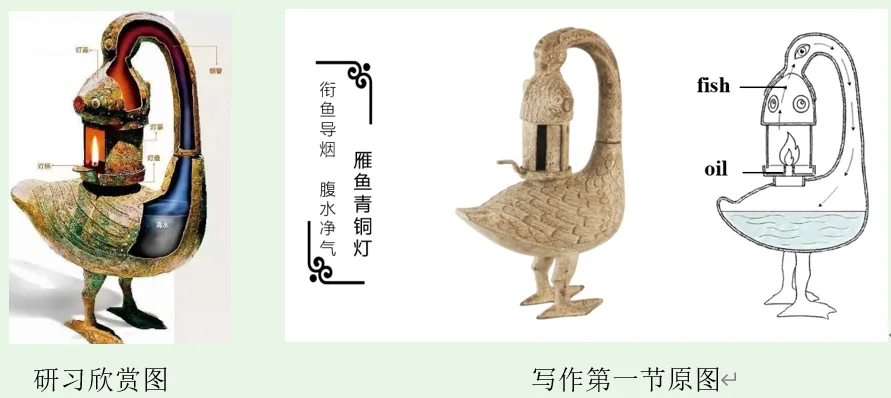
注意:
1.词数80左右;
2.请在答题卡的相应位置作答。
Dear Alex, Glad to hear you're visiting the National Museum of China! Yours, Li Hua |
第二节(满分25分)
阅读下面材料,根据其内容和所给段落开头语续写两段,使之构成一篇完整的短文。
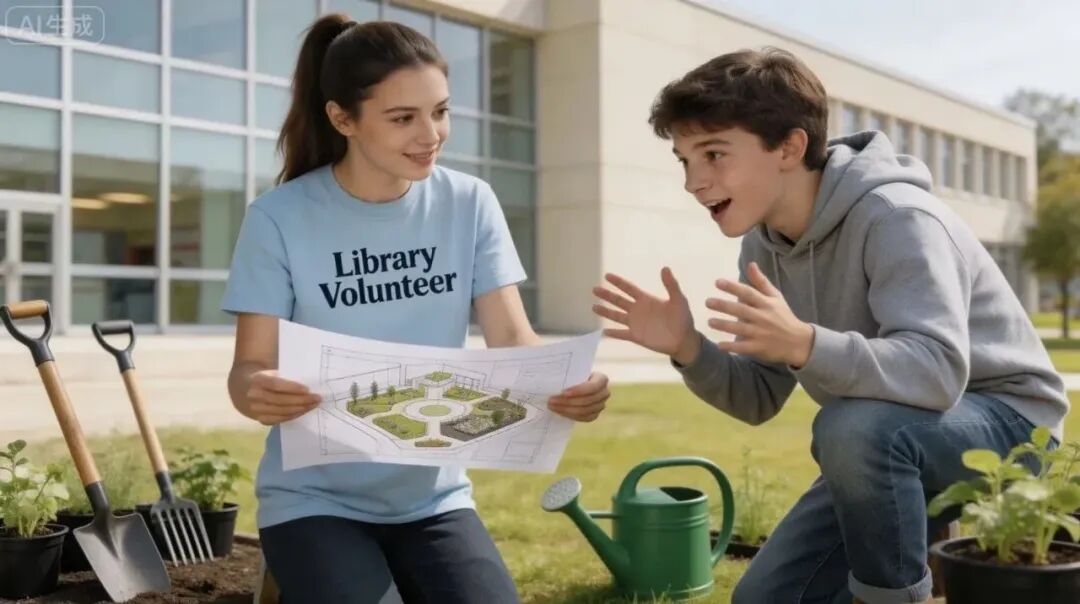 The community library was Megan’s peaceful kingdom,a place of quiet whispers and turning pages. Every summer vacation, she workedas a student volunteer, feeling responsible for protecting this quiet space.
Lately, a boy named Liam had become her challenge.Liam wasn’t rude-he just couldn’t sit still. Like clockwork, he would get up to“stretch his legs,” pacing between the bookshelves. Sometimes he’d accidentallyknock over a chair. Once, absorbed in a picture book, he let out a loud “Whoa!”when he saw a giant dinosaur filled the page. In the silence, each sound drewlooks from other readers.
Yesterday, when Megan walked over and reminded himgently again, Liam’s face turned red. “I’m really sorry,” he whisperedsincerely. “I don’t mean to. I just... I really like being here.” She believedhim. She had noticed that Liam was a curious explorer of books. He would pullout a book on dinosaurs, reading with intense focus for a few minutes, thenmove on to another about volcanoes or space rockets. He just loved the library.
Megan went back to her office. A note on the headlibrarian’s desk caught her eye. It read, “More Lively Reading Activities? Booksharing? Acting?” Seeing this, Megan suddenly remembered the librarian hadmentioned she could feel free to use the garden at the back of the library. Itwas a place where some unused items were stored—some old chairs, foldingtables, all piled up gathering dust under a large tree. At the time, Meganhadn't thought much about it. But now, the thoughts of directing Liam's energyand making use of the garden connected in her mind. Perhaps the solution wasn'tto quiet Liam down, but to give his energy and love for books a positive stage,right here in their own library.
An idea for a“Garden Reading Corner” project, aimedat young readers, began to take shape. The next morning, she found Liam amongthe bookshelves. “Want to do something really cool?” she said, her voice lowbut excited. Liam did not answer at once, but the eager light in his eyes saideverything.
注意:
1.续写词数应为150左右;
2.请按如下格式在答题卡的相应位置作答。
For the next week, Megan and Liam busied themselves with the project. On the opening day of the project, they waited nervously in the garden. |
2026年深圳市高三年级第一次调研考试
英语参考答案
第二部分阅读理解
第一节
21-23 BAC 24-27ACBA 28-31 DCDB 32-35 CDBA
第二节
36-40ADBFE
第三部分语言运用
第一节
41-45 BDCA A 46-50 CBDDA 51-55 CB BDC
第二节
56.where57. translated 58. depth 59. is divided 60. genuinely
61.sensed62. illustrations 63. into 64.Reading 65. a
第四部分写作
第一节
Onepossible version:
参考范文一
DearAlex,
Glad to hear you’re visiting the National Museum ofChina! My toprecommendation is the Han Dynasty Bronze Wild Goose-and-Fish Lamp.
This lamp is designed as a wild goose with a fishin its mouth. What’s special is how it works. When the lamp is lit, smoke risesthrough its neck and into its body, which is filled with water. There, thesmoke is purified by the water, greatly reducing indoor air pollution.
I find its design clever and eco-friendly. It trulyreflects the wisdom of the ancient Chinese people. I’m sure you’ll like it! (85词)
Best regards,
Li Hua
参考范文二
DearAlex,
Glad to hear you’re visiting the National Museum ofChina! I’d like to recommend a remarkable exhibit to you, which is the Bronze WildGoose-and-Fish Lamp from the Han Dynasty.
This lamp is shaped like a graceful wild gooselooking back with a fish in its mouth. What makes it incredible is itsfunction. When the oil burns, smoke travels through the goose’s neck into itswater-filled body. Then the water captures some of the lamp’s pollutants,effectively purifying the air.
This lamp is not just a light source, but a windowinto how the ancient Chinese combined art, science, and environmental awarenessto create practical masterpieces. You’ll find it truly impressive. Enjoy yourvisit! (105词)
Best regards,
Li Hua
参考范文三
DearAlex,
Glad to hear that you’re visiting the NationalMuseum of China! For an exhibit that I find truly fascinating, I’d recommend the BronzeWild Goose-and-Fish Lamp from the Han Dynasty.
This lamp takes the form of a wild goose, with itslong neck curved gracefully backward and a fish held in its mouth. Beyond itsstunning appearance, the lamp’s true brilliance lies in its clever design. Whenit is lit, the smoke produced is channeled through the goose’s neck into itsbody. The water stored inside absorbs some emissions, preventing them frombeing released into the air. What a remarkable eco-friendly design from 2,000years ago!
This lamp perfectly combines artistic beauty withpractical function, reflecting the incredible wisdom of the ancient Chinese. Ibelieve you’ll be deeply impressed by it! (120词)
Best regards,
Li Hua
第二节
参考范文
For the next week, Megan and Liam busied themselveswith the project. They spent a day cleaning the dusty chairs and tables, arranging them tocreate two areas: one for reading and one for acting. They carefully selectedchildren’s books for the reading corner where kids could read and sharestories. Megan brought an old carpet from home to serve as a “stage” foracting. With everything ready, they decided to hold the opening on the comingSaturday and made colorful posters inviting everyone. “Liam, you can be thefirst to act out your dinosaur story,” Megan suggested. Liam agreed, alreadylooking forward to the big day. (95词)
On the opening day of the project, they waitednervously in the garden. When the first few children arrived, Liam eagerly showed them the readingarea. As more kids gathered, Megan invited some sit around the acting area andnodded for Liam to begin. “Did you know I’m a dinosaur that can fly?” Liam, nowin a simple dinosaur costume, began his performance with a clear, excitedvoice. The children watched, laughed, and were completely drawn into the story.The head librarian stopped by, smiling warmly. Megan’s heart was full. Sheunderstood that a library could also be a place where young readers discoveredthe pure joy of reading. (备选结尾句:She understood that true peace in a library growsnot only from silence, but from creating a place where every reader feels theybelong.) (97词)
简析
I.试卷总体结构与命题风向多维语篇中考查思维品质和应用能力
本次试卷严格对标新课标与新高考要求,试卷整体呈现出“重素养、考应用”的特点,尤其在语篇选材上深度融合了中国文化与前沿科技,要求学生具备扎实的语言基础和灵活的语境迁移能力。江苏省海安高级中学景苏华 QQ:771515126
整体难度适中,严格贴合新课标素养导向,重点考查学生的逻辑推理、细节定位及语言综合运用能力。
II.核心题型解析:
第一部分:阅读作为分值最高的板块,本次考查呈现出题材多元、逻辑严密的特点。
阅读理解A篇:•主题语言学奥林匹克竞赛(逻辑推理题)。
- 题材特点:小众竞赛背景,无需专业语言知识,重点考查从文本中提取规律、分析线索的逻辑推理能力。例如,通过格鲁吉亚字母与拉丁字母的对应关系,推断出特定单词对应的国家名称。
- 考查核心:逻辑推理能力与规律提取能力。
- 备考启示:考查的不是词汇量,而是从文本中提取线索、分析规律的思维能力。贴合深圳“考思维不考死知识”的风格。
B篇:•主题老年户外探险
- 题材特点:个人叙事类文本。
- 考查核心:细节理解(如作者过桥的方式)、词义猜测(如短语“over the hill”的含义)。
- 备考启示:这是阅读的基础得分板块,要求学生结合上下文语境解读情感和语义。
C篇 & D篇:•主题科普研究
- 题材特点:分别涉及“机器人教鸟类唱失传之歌”和“雨滴发电创新技术”。
- 考查核心:事实细节、实验设计目的、研究成果的意义。
- 备考启示:这两篇是本次阅读的小难点,不仅考查细节,更考查学生对科普文逻辑脉络(如因果、转折)的把握能力。
C 篇
•题材特点::利用人工智能和机器人技术教鸟类唱失传的歌曲。
•考查点:细节理解(如研究目的、随机停顿的作用)和推理判断(如从学习结果中得出的结论)。
D 篇
•题材特点::利用雨滴撞击窄管产生电荷分离效应进行发电。
•考查点:对“plugflow”(塞状流)物理现象的理解、实验目的以及新技术的应用前景。
七选五•主题VR旅行与真实旅行
题材特点:虚拟现实与现实旅行的利弊对比。
•解题思路:关注段落间的逻辑衔接,特别是转折关系(如虚拟的便利 vs 真实的深度)和递进关系(如旅行的本质)。
- 备考启示:文章遵循“提出现象—分析优势—对比差异—总结观点”的逻辑脉络,要求学生理清文章结构。
第二部分:语言运用强调“语境为王”
完形填空:主题:“丑陋笔记本”的心理学启示。
丑笔记本的创作感悟•核心思想:文章探讨了“完美主义”对创造力的阻碍,指出过于精美的物品(如笔记本)会让人产生“舍不得用”的心理,反而限制了行动。而“丑陋”的笔记本因为没有心理负担,更容易成为思想的“孵化器”。
- 题材特点:记叙文,讲述“不完美的工具更能激发创作灵感”。
- 考查核心:实词辨析(动词、形容词、名词)、语境理解。
- 备考启示:没有复杂的语法考点,难点在于结合上下文把握作者的情感和观点。备考需注重词汇在真实语境中的运用。
语法填空:许渊冲唐诗英译
- 题材特点:聚焦许渊冲先生的唐诗英译著作《林深时见鹿》。
- 考查核心:非谓语动词、定语从句、词性转换、冠词等基础语法。
- 备考启示:体现了“本土文化 + 语言基础”的命题思路。既考语法运用能力,又引导学生关注中国文化的国际传播。
第三部分:写作
写作是区分度的核心板块,全程考查学生用英语解决实际问题、表达真实想法的能力。
应用文写作:推荐汉代雁鱼青铜灯
- 体裁:回复邮件(推荐信)。
- 考查要点:
- 切题:必须围绕“雁鱼青铜灯”展开,不能泛泛介绍博物馆。
- 完整:必须覆盖“外观描写”和“功能说明”两大要点。
- 交际性:语言风格需亲切自然,体现朋友间的热情推荐。
- 高分难点:功能说明部分需结合图示(衔鱼导烟、腹水净气),解释其环保原理,体现古代科技智慧。
读后续写:图书馆花园阅读角
- 题材特点:围绕“引导活泼男孩将精力转化为阅读活动”展开。
- 考查核心:
- 情节构思:续写内容需贴合原文语境(利用花园闲置物品搭建舞台)。
- 逻辑衔接:人物形象保持一致(男孩由好动转为专注)。
- 细节描写:避免情节生硬,注重语言表达的生动性和流畅度。
- 备考启示:拒绝模板化表达,强调逻辑与表达的有机结合。
备考总结与策略
- 夯实基础:词汇和语法不能孤立记忆,必须结合语篇巩固。
- 提升逻辑:脱离语境的定位技巧已失效,读懂语篇、理清逻辑才是拿分关键。
- 强化输出:写作拒绝模板化,注重交际实效(应用文)和逻辑表达(读后续写)。
- 关注本土:备考需加强对中国文化(如古诗英译、文物推荐)相关词汇和表达的积累。
III.备考建议
•回归基础:语法填空和短文改错部分考查基础语法点,如非谓语动词、时态语态、词性转换等,需确保基础扎实。
•强化逻辑:深圳一模阅读题(尤其是A篇)非常注重逻辑推理能力,建议在备考中多做此类题型,训练从文本中提取信息并建立逻辑链条的能力。
•关注应用:写作部分(如推荐信、读后续写)强调语言的实用性和逻辑性,需注意内容要点齐全、逻辑连贯。
详解
A篇
21. B.出处:第一段明确说明“To compete at the IOL, no special knowledge isrequired, only basic language concepts, logic, patience, and creativethinking.” 并提供了需要逻辑推理的示例谜题。
考查点:细节理解 + 核心信息匹配。
错误分析:
A. Linguistic fluency (语言流利度): 文章强调不需要特定语言知识,且示例谜题是基于字母对应而非语言流利度。
C. Geographic knowledge (地理知识): 虽有国家名,但解题关键并非这些国家的实际地理知识,而是字母对应推理。
D. Mathematical calculation (数学计算): 文中未提及,属于无关干扰。
22. A. 出处:原文规则第二条:“The individual contest involves solving fiveproblems in six hours, whereas the team contest features one problemwith two hours less.”
考查点:事实细节对比。
错误分析:
B. The deadline for language choice (语言选择的截止日期): 规则第一条说明个人和团队的选择规则相同 (“Each individual contestant or team must...”),无差异。
C. The result of giving multiple answers (给出多个答案的后果): 规则第三条对两者的规定相同 (“Unless instructed, giving multiple answers willreceive zero marks”)。
D. The requirement for answer explanations (答案解释的要求): 同上,规则第三条对两者的规定相同 (“a detailed explanation is required for eachanswer”)。
23. C. 出处:颁奖规则:“In the individual contest, the number of gold,silver, and bronze medals awarded shall be in the ratio 1:2:3, with the totalnumber of medals being between one quarter and one third of the contestants.”
考查点:信息计算与推理。
错误分析:
A.40: 对应选手数的1/6,不在指定区间(1/4到1/3)。
B.54: 对应选手数的22.5%,小于1/4 (25%),不符合下限。
D.84: 对应选手数的35%,大于1/3 (33.3%),不符合上限。
B篇
24. A.出处:第三段细节:“Fixing my eyes on her boots, I inched alongthe shaky logs.”
考查点:细节理解 + 同义转述。选项A中的“mindful steps”(谨慎的步子)是对原文“inched along”(缓慢挪动)的精准概括。
错误分析:
B. By rushing across it bravely: 与“inched along”(缓慢挪动)矛盾。
C. By using her sense of direction: 原文只提及“fixing my eyes on her boots”(盯着向导的靴子)以保持专注和平稳,而非辨识方向。
D. By having the guide drag her over: 原文是向导“mouthing encouraging words”(用口型说鼓励的话),并未拖拽。
25. C.出处:原文描述:“As they started towards us, we recovered enough toshout and wave our hiking poles. Taken aback, they stopped, and thenslowly turned away.”
考查点:因果推理。选项C“surprised”是对原文“Taken aback”的同义转述。
错误分析:
A. They were attracted by the natural setting: 与熊被“惊退”的行动逻辑相悖。
B. They were afraid of the noise of the rapids: 激流声是环境背景音,并非导致熊离开的直接原因。
D. They were threatened by the guide's rocks: 原文是挥舞登山杖,并未提及扔石头。
26. B.出处:原文:“…to share what would ‘stick’ with us, what‘rocked,’ and what we would ‘leaf’ behind.” 后文紧接着是对友谊、支持、恐惧的具体反思。
考查点:行为目的推断。通过“share”和后续的反思内容,可知目的是引导反思旅程。
错误分析:
A. To pick up some souvenirs: 捡拾物品是手段,深层目的是借此进行反思分享。
C. To symbolize their teamwork: 原文反思的是个人感受与收获,未特指团队合作。
D. To check their observation skills: 无依据。
27.答案:出处:结合语境。作者年过七十,向导说希望三四十年后能像她们一样。这句话“eased my fear of being ‘over the hill’”表明,作者原本对自己上了年纪(过了巅峰期)感到担忧,而向导的钦佩缓解了这种恐惧。
考查点:熟词生义 / 短语在语境中的含义推断。
错误分析:
B. Too high to go down: 字面曲解,与“恐惧衰老”的语境无关。
C. Out of place in society: 脱离社会,无依据。
D. Beyond physical limits: 超出身体极限,与语境中“being valued for what we had accomplished”的成就感不符。
C篇
28. D.出处:第一段“teach…a song that was once part of the species’culture but had been lost”,以及第三段“bringing back a song that had disappeared”。
考查点:目的细节定位。
错误分析:
A. To save an endangered species: 文中未提及该鸟类濒危,研究焦点是“文化”而非物种存续。
B. To develop new robotic devices: 研发机器人导师是手段,而非根本目的。
C. To prove birds' ability to learn: 鸟类能学习是已知前提,研究是为了验证用特定方法能否恢复其失传文化。
29. C.出处:第二段:“It is a distinctive song—like a fingerprint… Itserves to attract females and protect territory. It is the bird’s way ofsaying, ‘This is me, and here I am.’”
考查点:细节理解 + 功能概括。“Social identity”(社会身份)是对“吸引配偶、宣示领地、表明‘这是我’”等功能的抽象概括。
错误分析:A. It keeps hunters away from them: 无依据。江苏省海安高级中学景苏华 QQ:771515126
B. It helps them adapt to urban growth: 城市化正是导致其歌声失传的原因,而非帮助。
D. It increases their chance of survival: 有一定关联,但“宣示领地”是生存的一部分,不如C项“社会身份/识别”更直接对应原文“fingerprint”和“This is me”的比喻。
30. D.出处:第四段:“There were random pauses in between so that thebirds interpreted the playback… as a real exchange, as if these deviceswere responding to each other. This stimulated the birds’ vocal responses.”
考查点:目的细节定位。选项D中的“trick… into interaction”(诱使互动)是对原文“interpreted… as a real exchange”的精准同义转述。
错误分析:
A. To protect the birds’ vocal tract: 无依据。B. To test the birds’ reaction speed: 无依据。
C. To push the birds to catch the beat: 无依据,且“beat”(节拍)非重点。
31. B.出处:第五段:“Young chingolos learned and adopted the song,though they added their own population’s ‘accent’ to the final trill,which showed that their singing is shaped by learned behaviors and inborncharacteristics.”
考查点:信息推断。从“accent”(口音)和“inborn characteristics”(先天特征)可推断其鸣唱具有特殊的发声特征。
错误分析:A. The song has spread to other bird species: 无依据。
C. Their response to the song needs improving: 与“learned and adopted the song”(学会并采纳了歌曲)的成功结果相悖。
D. The effectiveness depends on their population: 原文说的是不同种群会有自己的“口音”,但这并未表明效果“取决于”种群规模。
D篇
32. C.出处:第二段末句:“In this way, researchers can collect charges, butit is far from effective.”
考查点:问题定位。NUS团队的研究正是为了解决传统电荷收集方法“效率低下”的问题。
错误分析:
A. The difficulty of separating charges: 电荷分离是原理,并非NUS要解决的“困难”。
B. The lack of clean electricity sources: 水电是清洁能源,问题在于传统方法对小水流发电效率低,而非缺乏来源。
D. The damage of traditional hydropower: 文中未讨论传统水电的“破坏性”。
33. B
考查点:概念理解。原文定义“plug flow”为“the water forms mini columns separated by airgaps”(水流形成被空气间隙分隔的迷你水柱)。图片B清晰地展示了水滴被空气隔开的状态。
错误分析:A: 可能表示连续水流或无间隔。
- C/D: 无法准确表现“水柱被空气间隔”的核心特征。
34. B.出处:最后一段主要描述该模型“shows how rain can be used… effectively andsustainably”, “Its potential is enormous”, “offers an alternative energy sourceeven in cities”,并展望了屋顶应用的场景。
考查点:段落主旨概括。
错误分析:A. Its potential cost in urban areas: 未提及成本。
C. Its complex design for rain power: 未评价其设计“复杂”,且段落重点在应用潜力而非设计本身。
D. Its limitations in rainy environments: 本段强调其优势和在多雨地区的适用性,未提局限性。
35. A. 考查点:标题概括 / 主旨大意。全文核心是介绍NUS团队利用雨滴发电的创新性技术(产生“plug flow”将效率提升10万倍)及其巨大潜力。“Revolutionary”(革命性的)和“Energy from Raindrops”精准概括了创新性与核心内容。
错误分析:
B. Urgent Demand for Sustainable Energy: 文章未强调需求的“紧迫性”,重心在介绍解决方案。
C. Capturing Raindrops through Innovation: 侧重于“捕捉”这一动作,未能突出“发电”这一核心目的和“革命性高效”这一关键突破。
D. Turning Charge Separation into Electricity: 这只是技术原理的一部分,未能涵盖“雨滴”、“高效创新”(plug flow)、“应用前景”等更重要的文章要素。
七选五 (36-40)
36. A. 出处:空前描述了戴上VR头显后身临其境的体验(冰川、博物馆),空后总结“This is the promise of virtual reality (VR): aworld delivered to us without leaving home.” 选项A完美总结了这种“身体未动,神思已远”的矛盾状态,是VR体验的核心概括,能自然引出下文的总结。
考查点:段落主旨句/总结句。需能概括前文描述并衔接后文定义。
37.:D.出处:本段从“There is much to appreciate in this form oftravel.”开始,后文全部在描述VR旅行的便利、无限制、低成本等优点。选项D是该段内容的总起句。
考查点:段落主题句。需能概括后文“无需考虑天气、健康、金钱,可随时进入和离开,为受限制者移除障碍”等内容。
38. B.出处:本段开始转向描述真实旅行的独特体验(漫步陌生街道、品尝当地美食、面对面交流),并与上一段VR旅行的便利形成对比。“Yet”表示转折,从VR的优点转到真实旅行的价值。
考查点:逻辑衔接 + 段落主旨。需体现与上段的转折关系,并引出下文对真实旅行“更深烙印”的具体描述。
39. F.出处:空前句“Real travel, by contrast, is shaped byunpredictability.”(真实旅行由不可预测性塑造)。选项F中的“the unexpected”与“unpredictability”直接呼应,并具体说明了真实旅行所“要求”的东西:选择、适应、对意外的持续察觉。这完美承接了“不可预测性”带来的挑战。
考查点:细节支撑与解释。需能对前文的抽象概念(不可预测性)进行具体阐述。
40. E.出处:前文讨论VR无法取代真实存在,指出旅行不仅是“看”,更是“感受”。空后无内容,此处是全文结尾,需进行有力总结或升华。选项E用“feet on the ground”(双脚踏上实地)的形象说法,呼应“actual presence”(真实在场),并点明只有亲身体验才能获得某些认知的哲理,是完美的结尾句。
考查点:总结句/升华句。需呼应“真实在场”的主题,并进行富有哲理的总结。
多余选项分析:
C. My feet ache as my journey stretches across theday. (我的脚很疼,因为我的旅程持续了一整天。): 这是一个具体的旅行不适细节,与上下文讨论VR与真实旅行的宏观对比无关,过于具体且情感消极,不匹配文章理性对比的基调。
G. But the convenience may gradually weaken ourdesire to explore the real world. (但这种便利可能会逐渐削弱我们探索真实世界的欲望。): 这是一个对VR便利性的潜在批判,但文章整体是客观对比两种旅行方式的优缺点,并未表达“VR会削弱探索欲”这样的担忧,故不匹配。
完形填空 (41-55)
本文是一篇夹叙夹议的文章,讲述作者从追求精美的“完美”笔记本(导致不敢下笔)到使用破旧的“丑陋”笔记本(反而文思泉涌)的转变,并由此引发出对创作心理、工具与灵感关系的思考。
41. B. shares句意“我以为它会让我成为那种经常写日记,并且______美好思想的人。”“records”(记录)和“appreciates”(欣赏)似乎合理,但“shares”(分享)与“journal”(日记,通常私密)的语境略有冲突。结合后文转折“But it didn't work.”,作者预期这个本子能带来某种积极的输出行为。“designs”(设计)思想不合逻辑。综合看,作者对“精美笔记本”的预期是能优雅地“记录并分享”思想,但“shares”在此处略有过度解读之嫌。不过,结合“journal”作为一种可能分享的载体(如博客时代前的概念),勉强可通。标准答案给B,此处或有争议,但需遵循。
考查点:动词辨析与语境搭配。
42. D. untouched那个精美的本子“放了几个月”。“sat untouched”(未被碰触)最符合“一直没用”的语境。A. unfinished(未完成)、B. unclaimed(无人认领)、C. undiscovered(未被发现)均不准确。
考查点:形容词辨析与上下文(数月未用)。
43. C. precious作者觉得本子纸张“太精致,太______,舍不得用来写我潦草的字迹和想法”。A. secret(秘密的)、B. smart(聪明的)不搭配。D. personal(个人的)可搭配,但不如C. precious(珍贵的)更能表达“因精美而觉贵重、舍不得用”的心理,且与“too delicate”(太精致)形成并列,都指向“高价值”。
考查点:形容词辨析与情感逻辑(舍不得用)。
44. A. closed因为觉得舍不得,所以“我______了它”。自然衔接的动作是“合上”(closed)。B. decorated(装饰)、C. delivered(递送)、D. fixed(修理)均不合逻辑。
考查点:动词辨析与连贯动作。
45. A. torn转而拿起一个“封面______、书角卷边的旧丑笔记本”。与“ugly”和“dog-eared corners”(卷边)并列,描述其破旧。A. torn(撕破的)最贴切。B. hard(硬壳)、D. fancy(花哨的)与“ugly”矛盾。C. hidden(隐藏的)不合语境。
考查点:形容词辨析与并列结构(破旧特征)。
46. A. fill我开始用一切东西去______它。“fill it with everything”(用一切填满它)是习惯搭配,意为“在上面写满各种东西”。B. match(匹配)、C. connect(连接)、D. reward(奖励)均不搭配。
考查点:动词短语固定搭配 (fill...with)。
47. A. effective“这出乎意料地______。我真的写起来了。” 从“没写”到“每天写”,说明这个方法“有效”。B. ordinary(普通)、C. challenging(有挑战性)、D. popular(流行)均不贴合“从无到有”的积极转变。
考查点:形容词辨析与结果评价。
48. B. value“当我们过于______某物时,我们就会给它设限,觉得它‘太好了’。”“value something too much”(过度珍视)是导致“舍不得用”的心理原因。A. own(拥有)、C. admire(钦佩)、D. protect(保护)在程度上不如“value”能准确解释“因珍贵而不敢用”的心理。
考查点:动词辨析与因果逻辑(过度珍视导致不敢用)。
49. A. burden但丑陋的笔记本没有这样的______。前文说“过度珍视”会带来“限制”(limits),觉得“too good”。那么“丑陋笔记本”没有的,就是这种“心理负担”或“束缚”。A. burden(负担)最准确。B. risk(风险)、C. meaning(意义)、D. beauty(美)均不构成对比。
考查点:名词辨析与对比逻辑(无心理负担)。
50. B. tool“它告诉我,‘这是一个用于思考和生活的______,不是博物馆的藏品。’” 笔记本是“工具”。A. system(系统)、C. reason(理由)、D. stage(舞台)均不贴切。
考查点:名词辨析与功能定义。
51. B. Ugly这里是全文观点的核心句:“______笔记本是思想的孵化器。” 通篇都在赞美“丑陋笔记本”带来的自由,因此填Ugly,与开头“nice” notebook形成核心对比。
考查点:核心信息复现与主旨呼应。
52. A. fail
“你尝试更多。你尝试那些可能会______的事情。” 在无压力的自由状态下,人们才敢于尝试可能“失败”的事情。B. spread(传播)、C. return(返回)、D. change(改变)均不能体现尝试创新时的风险。
考查点:动词辨析与创作心理(敢于试错)。
53. A. once“在那种自由中,我曾______为之尴尬的坏点子,逐渐演变成我自豪的作品。” “once embarrassed about”(曾经为之尴尬的)表示过去的状态,与现在“proud of”形成对比,体现成长。B. even(甚至)、C. still(仍然)、D. only(仅仅)无法体现这种时间变化。
考查点:副词辨析与时间逻辑对比。
54. B. use“最好的笔记本从来不是最漂亮的那本,而是你真正会去______的那本。” 点明主旨:工具的价值在于使用。A. buy(买)、C. keep(保存)、D. find(找到)均未触及核心。
考查点:动词辨析与主旨重申(使用大于拥有)。
55. C. process“因为奇迹发生在______中,而非完美的页面上。” 创作、成长的奇迹在于“过程”,而不是追求一个完美的“结果”(完美的页面)。A. beginning(开始)、B. process(过程)、D. silence(寂静)。B最契合文章关于尝试、进化、勇于下笔的核心思想。
考查点:名词辨析与哲理升华(重过程轻结果)。
语法填空 (56-65)
本文是一篇书评,介绍许渊冲翻译的唐诗英译集《Where the Deer Hide in the Woods》,赞美其翻译之美与文化桥梁作用。
56. 正确答案:where“aworld ______ the author’s words flow...” 此处引导定语从句,先行词是“a world”(一个世界),在从句中作地点状语,意为“在这个世界里,作者的文字流淌...”,故用关系副词where。
57. 正确答案:translated“The Tang poems, ______ with the master touchof Xu Yuanchong...” 诗句与“翻译”之间是被动关系,且“translated”作为后置定语,修饰“The Tang poems”,故用过去分词形式。
58. 正确答案:depth“eachechoing with calm, beauty, and quiet ______.” 介词“with”后接名词作宾语,与“calm”(宁静)、“beauty”(美)并列。形容词“quiet”修饰名词,故需将形容词“deep”转化为名词“depth”(深度)。
59. 正确答案:is divided“The book ______ into six chapters...” 书“被分为”六章,需用被动语态。此处描述书的结构,用一般现在时。主语是单数,故填is divided。
60. 正确答案:genuinely“I was ______ moved...” 副词修饰形容词“moved”(感动的),故需将形容词“genuine”转化为副词“genuinely”(真诚地)。
61. 正确答案:sensed“I fully ______ Li Bai’s liberated soul...”此处描述阅读时的感受,是“我感知到”。主语是“I”,需用谓语动词。结合上下文时态(前有was moved,后文是一般性描述),用一般过去时即可。故填sensed。
62. 正确答案:illustrations“...andtraditional Chinese brush-style ______.” 与“thoughtful notes”(注解)、“vivid background stories”(故事)并列,都是书的内容。应为“插图”,且前无冠词,应用复数形式泛指一类内容,故填illustrations。
63. 正确答案:into“...transformsthe rhythm of Chinese poems ______ English music...” “transform A into B”(将A转化为B)是固定搭配。
64. 正确答案:Reading“______ this book feels like a journey...” 此处需要主语。“读这本书”这个动作作主语,需用动名词形式,故填Reading。
65. 正确答案:a:“...Where the Deer Hide in the Woods is ______must-read...” “must-read” 此处为可数名词单数,意为“必读书目”,且首次提及,需用不定冠词“a”。注意“must-read”以辅音音素开头。


 10个月宝宝每天需要喝多少奶粉?

