参考文献:
References:
[1]佚名.蓝绿交汇演绎什么样的生态逻辑?:关于我国重点湾区生态文明建设的报告[J].中国生态文明,2016(2):23-33.
[2]张昱,陈俊坤.粤港澳大湾区经济开放度研究:基于四大湾区比较分析[J].城市观察,2017(6):7-13.ZHANG Y, CHEN J K.The economic openness of Guangdong-Hong Kong-Macao greater bay area: a comparative analysis of four renowned bay areas[J].Urban insight, 2017(6):7-13.
[3]大卫·博依斯,胡·威廉姆斯.城市出行预测学:历史现状与未来[M].宇恒可持续交通研究中心,译.北京:人民交通出版社股份有限公司,2021.Boyce D, Williams H.Forecasting urban travel:past,present and future[M].The China Sustainable Transportation Center,translated.Beijing: China Communications Press Co., Ltd.,2021.
[4]陈晨.1965年以来香港公共交通发展与运输政策演进[J].国际城市规划,2011,26(2):67-73.CHEN C.The evolution of transportation policy and public transport development in Hong Kong since 1965[J].Urban planning international,2011,26(2):67-73.
[5]全永燊,潘昭宇.建国60 周年城市交通规划发展回顾与展望[J].城市交通,2009,7(5):1-7.QUAN Y S, PAN Z Y.Development of urban transportation planning: looks back & ahead at 60th anniversary of P.R.China[J].Urban transport of China,2009,7(5):1-7.
[6]香港规划署.“北往南来”:二零一七年年跨界旅运统计调查[R].香港:香港规划署,2018.Hong Kong Planning Department.“Northbound Southbound” cross- boundary travel survey[R].Hong Kong: Hong Kong Planning Department,2018.
[7]深圳市规划和国土资源委员会.2013年深港跨界交通调查[R].深圳:深圳市规划和国土资源委员会,2014.
[8]深圳市规划和国土资源委员会.2015年深港莞惠跨界交通调查[R].深圳:深圳市规划和国土资源委员会,2016.
[9]深圳市规划和国土资源委员会.2017年深港莞惠跨界交通调查[R].深圳:深圳市规划和国土资源委员会,2018.
[10]深圳市规划和自然资源局.2019 年深港莞惠跨界交通调查[R].深圳:深圳市规划和自然资源局,2020.
[11]LIU J X, SHI W Z.A cross-boundary travel tale: unraveling Hong Kong residents' mobility pattern in Shenzhen by using metro smart card data[J].Applied geography, 2021,130:102416.
[12]方煜,石爱华,孙文勇,等.粤港澳大湾区多维空间特征与融合发展策略[J].城市规划学刊,2022(4):78-86.FANG Y, SHI A H, SUN W Y.Multi-dimensional spatial characteristics and integrated development strategy of Guangdong-Hong Kong-Macao greater bay area[J].Urban planning forum,2022(4):78-86.
[13]金勇进,杜子芳,蒋妍.抽样技术[M].第四版.北京:中国人民大学出版社,2015:15-35.JIN Y J, DU Z F, JIANG Y.Sampling technique[M].4th ed.Beijing: Chinese Renmin University Press,2015:15-35.
[14]刘建平,王克林.中美抽样调查发展的比较与思考[J].统计研究,2009(9):21-27.LIU J P, WANG K L.Comparison and thoughts on the sampling survey development between China and the United States[J].Statistical research,2009(9):21-27.
[15]贺明光,孙杨,叶臻.新时期综合交通运输规划调查方法研究[J].综合运输,2018,40(12):50-56.HE M G,SUN Y,YE Z.Research on investigation methods for comprehensive transportation planning in new era[J].China transportation review,2018,40(12):50-56.
[16]贾俊平,何晓群,金勇进.统计学[M].第六版.北京:中国人民大学出版社,2015:152-154.
[17]伊学义,王亦兵.贸易统计抽样调查样本量的研究[J].中国统计,2004(2):20-22.
[18]朱洪,陈欢,范瑱,等.移动互联背景下的上海市人员出行调查关键技术实践与创新[J].交通与港航,2022,9(2):77-81.ZHU H, CHEN H, FAN Z, et al.Practice and innovation of key technology of Shanghai travel characteristics investigation in the context of mobile internet[J].Communication&shipping,2022,9(2):77-81.
[19]深圳市规划和自然资源局.2020 年深圳市居民出行调查及分析[R].深圳:深圳市规划和自然资源局,2022.
[20]BARUA B, BOBERG J, HSIAO S, et al.Integrating geographic information systems with transit survey methodology[J].Transportation research record: journal of the Transportation Research Board, 2001, 1753(1):29-34.
[21]戴霄,陈学武.单条公交线路的IC 卡数据分析处理方法[J].城市交通,2005,3(4):73-76.DAI X, CHEN X W.The method of intelligent card data analysis for one public transportation route[J].Urban transport of China,2005,3(4):73-76.
[22]周崇华.基于IC 卡数据的深圳地铁OD 信息处理技术[J].城市轨道交通研究,2007(1):54-56.ZHOU C H.OD matrix of Shenzhen subway based on IC data[J].Urban mass transit,2007(1):54-56.
[23]杨飞,裘炜毅.基于手机定位的实时交通数据采集技术[J].城市交通,2005,3(4):63-68.YANG F, QIU W Y.Mobile phone location based real time traffic data collection- research[J].Urban transport of China, 2005, 3(4):63-68.
[24]张永强.浮动车交通信息采集系统研究[D].南京:东南大学,2005.ZHANG Y Q.Traffic data collection based on probe vehicle[D].Nanjing:Southeast University,2005.
[25]黄美灵,陆百川.基于手机定位的交通OD数据获取技术[J].重庆交通大学学报(自然科学版),2010,29(1):162-166.HUANG M L,LU B C.Traffic OD data collection technology based on mobile phone location[J].Journal of Chongqing Jiaotong University (natural science), 2010, 29(1):162-166.
[26]侯艳,何民,张生斌.基于公交IC 卡刷卡记录的居民出行OD推算方法研究[J].交通信息与安全,2012,30(6):109-114.HOU Y,HE M,ZHANG S B.Origin-destination matrix estimation method based on bus smart card records[J].Journal of transport information and safety,2012,30(6):109-114.
[27]李娜,董志国,薛美根,等.上海市第五次综合交通调查新技术方法实践[J].城市交通,2016,14(2):35-42.LI N, DONG Z G, XUE M G, et al.The practice of new survey technology and methodology in the 5th Shanghai comprehensive transportation survey[J].Urban transport of China,2016,14(2):35-42.
[28]苏跃江,温惠英,韦清波,等.多源数据融合驱动的居民出行特征分析方法[J].交通运输系统工程与信息,2020,20(5):56-63.SU Y J,WEN H Y,WEI Q B,et al.Resident travel characteristics analysis method based on multi-source data fusion[J].Journal of transportation systems engineering and information technology,2020,20(5):56-63.
[29]金勇进,刘晓宇.大数据背景下的抽样调查[J].系统科学与数学,2022,42(1):2-16.JIN Y J, LIU X Y.Sampling survey in the context of big data[J].Journal of systems science and mathematical sciences, 2022, 42(1):2-16.
[30]金勇进,刘展.大数据背景下非概率抽样的统计推断问题[J].统计研究,2016,33(3):11-17.JIN Y J, LIU Z.Statistical inference problems of non-probability sampling under the background of big data[J].Statistical research,2016,33(3):11-17.
[31]凌鹏,诸彤宇,周轶,等.基于人群出行行为轨迹的城市功能区识别[J].计算机工程,2022,48(7):36-41.LING P, ZHU T Y, ZHOU Y, et al.Urban functional areas identification based on crowd travel behavior trajectory[J].Computer engineering,2022,48(7):36-41.
[32]刘志远,张文波.交通大数据理论与方法[M].浙江:浙江大学出版社,2020:89-263.
深圳市跨界交通调查理论与技术研究
谭泽芳1, 2, 3,周军1, 2,黄嘉俊1, 2,杨心怡1, 2,胡家琦1, 2
(1.深圳市规划国土发展研究中心,广东 深圳 518040;2.广东省城市规划与交通仿真决策工程技术研究中心,广东 深圳 518040;3.东南大学交通学院,江苏 南京 211189)
Theoretical and Technical Research on Cross-Border Transportation Surveys in Shenzhen
TAN Zefang1,2,3,ZHOU Jun1,2,HUANG Jiajun1,2,YANG Xinyi1,2,HU Jiaqi1,2(1.Shenzhen Urban Planning & Land Resource Center, Shenzhen Guangdong 518040, China; 2.Guangdong Urban Planning & Traffic Simulation Decision Engineering Technology Research Center, Shenzhen Guangdong 518040, China; 3.School of Transportation, Southeast University, Nanjing Jiangsu 211189,China)
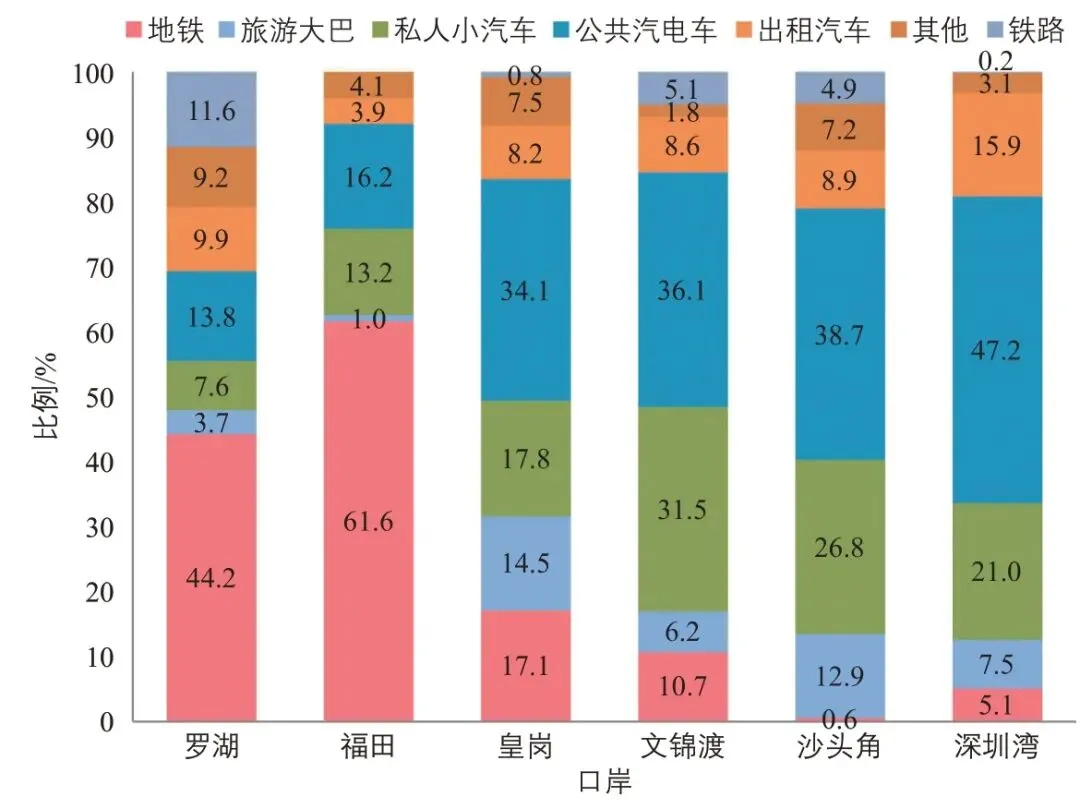
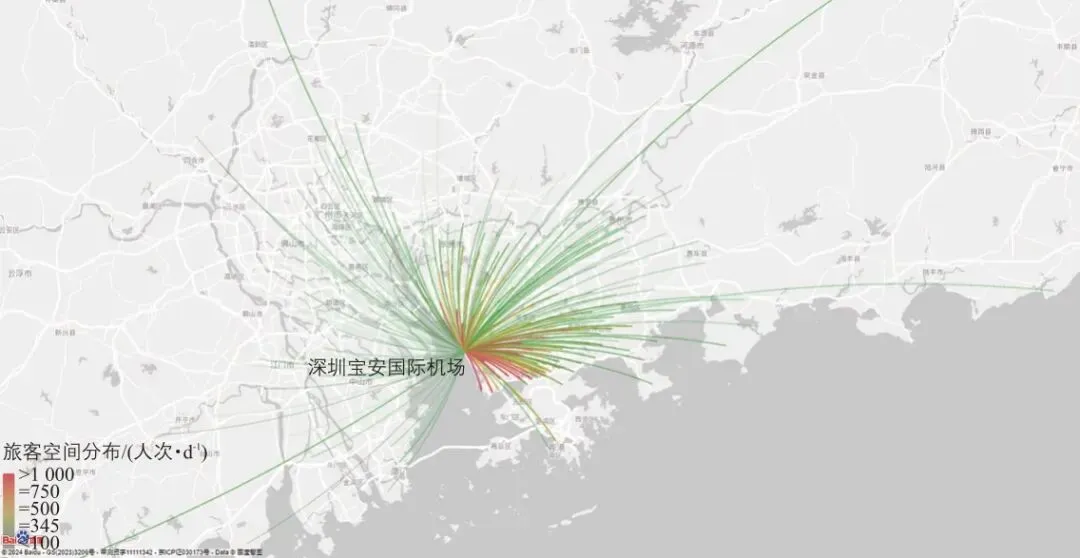
Abstract:The Bay Area is a key economic growth hub in China.Obtaining accurate cross-border transportation characteristics and patterns is crucial for measuring factors such as economic development, population mobility, and goods movement.This paper presents a review of the domestic and international development history of cross-border transportation surveys and systematically explores the theoretical foundations of cross-border transportation surveys in major cities within the Bay Area.The paper summarizes the urban planning and management needs for cross-border transportation surveys and establishes a survey framework guided by experience evaluation and new technologies and methods evaluation of big data.Specific survey methods are proposed in the framework, including sample size design, data verification, data expansion,and big data integration.Finally,using examples such as the spatial distribution of cross-border passengers between Shenzhen and Hong Kong,the distribution of connecting modes on the Shenzhen side,and the spatial distribution of passengers at Shenzhen Airport based on mobile signaling and survey data,the paper verifies the effectiveness of cross-border transportation survey methods and the feasibility of improving indicator accuracy.The method provides valuable insights for cross-border transportation surveys in regions such as the Bay Area,urban agglomerations,and metropolitan areas.
Keywords: transportation planning; cross-border transportation surveys; sampling techniques; big data methods;Bay Area;Shenzhen
文章编号:1672-5328(2025)02-0106-11
中图分类号:U491.1+1
文献标识码:A
DOI: 10.13813/j.cn11-5141/u.2024.0032
收稿日期:2023-07-18

 是简单随机抽样总体均值-
 ) 是
) 是 的估计量
的估计量 的方差,
的方差, ) 的无偏估计量
 为第
为第
 为第
为第 ) (定义为根据一个具体的样本计算出来的估计量的数值
 ) 的无偏估计时要求每层的样本量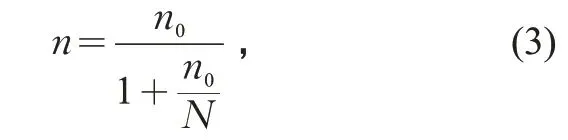





 10个月宝宝每天需要喝多少奶粉?

