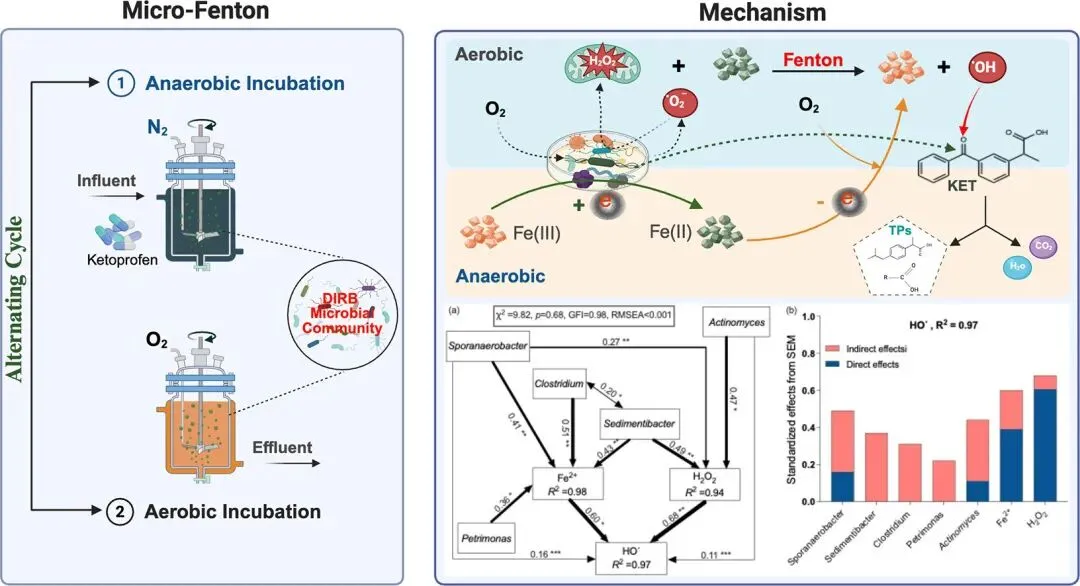
在此,我们提出一种基于群落驱动的MFenton范式,利用原生兼性厌氧DIRB菌群在近中性pH值(5.0–7.0)条件下实现自维持的HO˙生成。与单菌株系统(如单一菌株MFenton)不同,本共生体驱动策略通过功能冗余机制,在氧化还原条件波动时维持Fe(II)/H₂O₂协同共生生产,无需化学投入即可实现中性pH范围(5–7)的稳态运行,且不产生金属污泥,从而突破芬顿/电芬顿反应的酸性限制。该设计通过交替厌氧-好氧阶段模拟自然氧化还原波动,实现三重协同突破:(1) 基于DIRB呼吸的原位Fe(II)/H₂O₂协同生产;(2) 无需化学调节的pH耐受性MFenton催化;(3) 以微生物-自由基相互作用为主导的KET降解途径(而非非生物氧化)。通过结合微生物组分析与动力学建模,我们进一步解码了关键微生物属如何协调铁氧化还原循环与污染物转化。此外,还深入探究了影响该过程的关键因素、基础机制及KET降解的具体途径。本研究为环境中低能耗、无化学药剂的药物去除开辟了新路径,为可持续废水处理提供了创新方案。
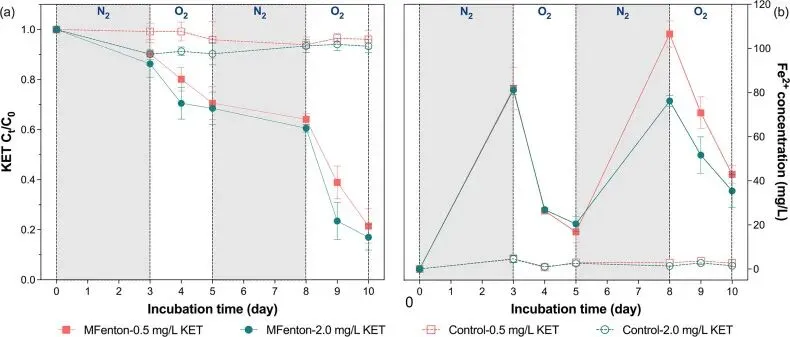
Fig. 1. KET degradation via MFenton driven by DIRB microflora. (a) The degradation kinetics of KET at different initial concentration (0.5 mg/L and 2.0 mg/L); (b) the corresponding variation of dissolved Fe2+ concentration during two anaerobic/aerobic (3/2 days) alternating cycles. Sampling times at day 0, 3, 4, 5, and 8, 9, 10 during two anaerobic/aerobic cycles. Error bars represent the standard deviations of three parallel samples (n = 3).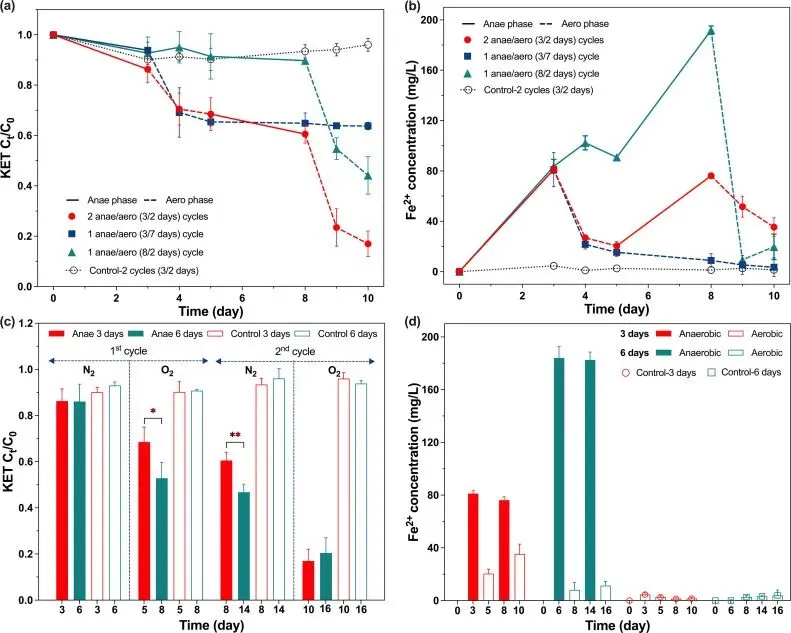
Fig. 2. Effect of different duration and number of anaerobic/aerobic cycles on KET degradation by MFenton. (a) Kinetic process of KET degradation via MFenton operated under 2 cycles of anaerobic/aerobic (3/2 days) alternation, 1 cycle of anaerobic/aerobic (3/7 days) alternation, and 1 cycle of anaerobic/aerobic (8/2 days), respectively; (b) the corresponding dynamic variation of Fe2+ generation by DIR accompanying with the MFenton operated under different cycles of anaerobic/aerobic alternation; (c) Influence of different anaerobic duration (3 and 6 days) on the degradation rate at some specific time; (d) the corresponding Fe2+ concentration during the bioprocess in different MFenton operated with different anaerobic duration. * and ** mean significant difference (p < 0.05) and highly significant difference (p < 0.01), respectively. Error bars represent of the standard deviations of three parallel samples (n = 3).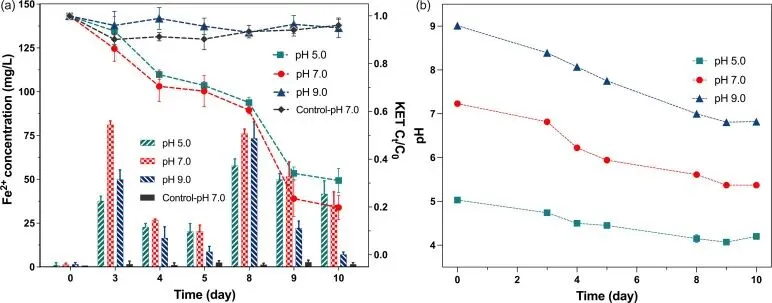
Fig. 3. The wide pH adaptability of MFenton for KET degradation. (a) Kinetic process of KET degradation and corresponding Fe2+generation during MFenton operated at different initial pH (5.0, 7.0, and 9.0); (b) dynamic variation of solution pH in the MFenton operated at different initial pH (5.0, 7.0, and 9.0). Error bars represent of the standard deviations of three parallel samples (n = 3).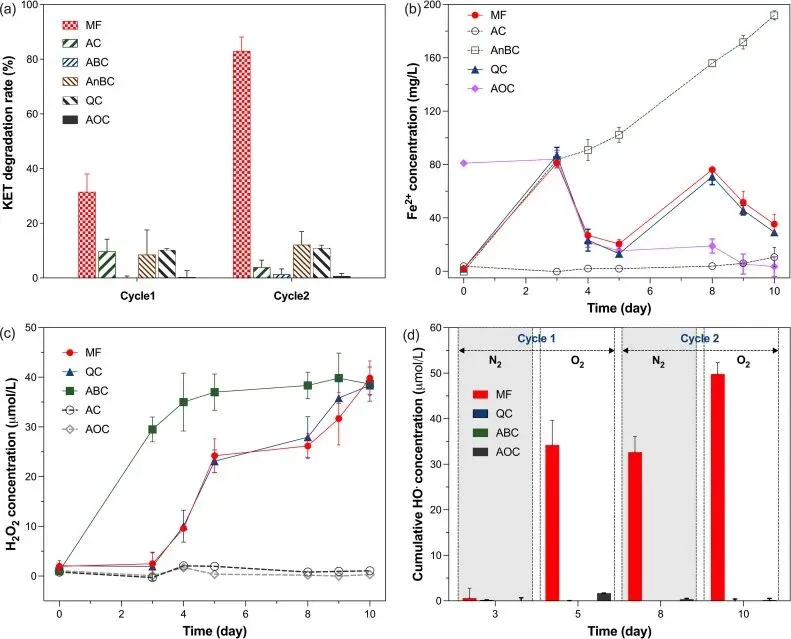
Fig. 4. KET degradation and the corresponding microbially mediated Fe redox cycling and H2O2 & HO˙ generation in the MFenton and different control groups. (a) Comparison of KET degradation between the MFenton and control groups conducting after 1 or 2 cycles; dynamic variation of corresponding microbially mediated (b) Fe2+and (c) H2O2 generation in the MFenton and control groups; (d) Cumulative sequentially produced HO˙ concentration in the MFenton and control groups conducting after 1 or 2 cycles. Abbreviations: MF, MFenton; AC, the abiotic control with no DIRB microflora; ABC, the strictly aerobic biotic control, AnBC, the strictly anaerobic biotic control; QC, the HO˙ quenching control with adding sufficient mannitol to scavenge HO˙; and AOC, the abiotic aerobic Fe2+ oxidation control. Error bars represent of the standard deviations of three parallel samples (n = 3).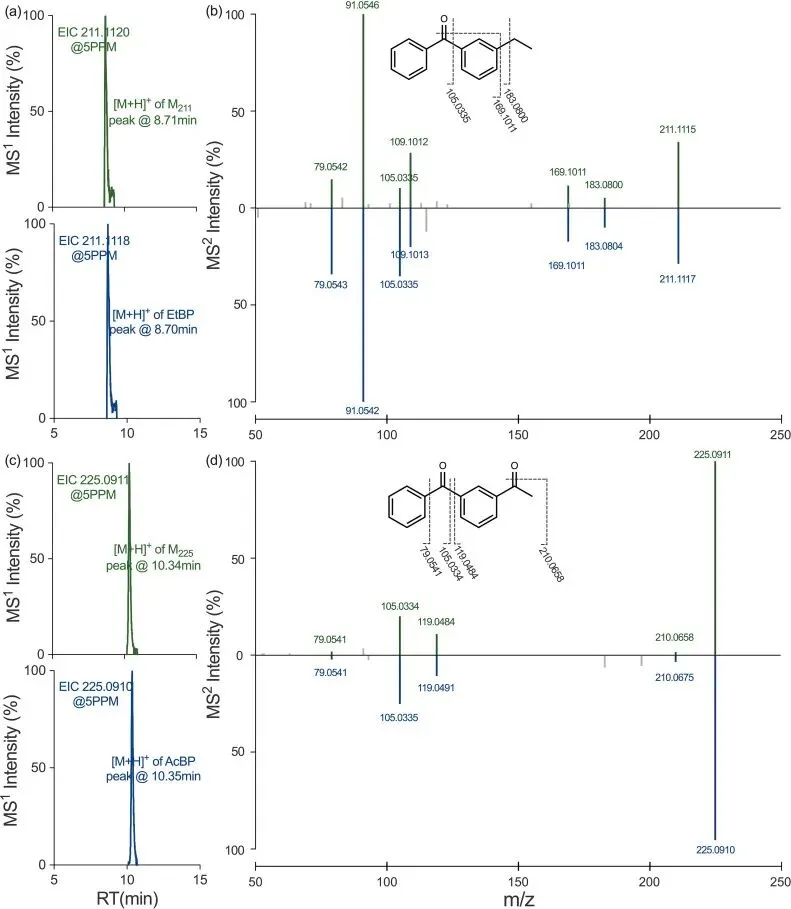
Fig. 5. Identification of M211 and M225 as 3-ethylbenzophenone (EtBP) and 3-acetylbenzophenone (AcBP) with confidence level 1 via reference standard crosschecking. (a)&(c) Extracted ion chromatograms (EIC) and (b)&(d) matched MS2 fragments of M211 and M225 extracted from culture solution (dark green) and EtBP and AcBP reference standard (dark blue) by UPLC-ESI-HRMS (ESI+). MS2spectra from culture solution and commercial standard were shown above and below the horizontal line. Characteristic fragmentation path of parent ion was shown as inset.本研究表明,原生兼性厌氧铁还原微生物群落能够驱动自维持的芬顿反应过程,在接近中性pH值(5.0-7.0)条件下,无需外源Fe²⁺或H₂O₂输入即可实现>80%的KET降解率。交替厌氧-好氧设计模拟自然氧化还原波动,实现原位Fe(III)/Fe(II)循环与生物源H₂O₂积累,协同产生负责KET降解的HO˙自由基。研究成功高置信度鉴定出十种潜在KET转位点。从机理层面,我们提出了KET的降解途径,包括脱羧、侧链氧化及酮基团中C-C键的断裂。关键菌属(如Sporanaerobacter、Sedimentibacter、Clostridium、Petrimonas和Actinomyces)在间接调控HO˙生成过程中发挥重要作用。微生物群落演替分析揭示,在交替的厌氧-好氧培养周期中,群落多样性与丰富度发生显著变化,厚壁菌门、拟杆菌门和放线菌门成为适应环境演变的关键门类。此外,曼特尔检验与扫描电子显微镜技术阐明了微生物群落组成、环境因子与Fe²⁺、H₂O₂及HO˙直接/间接调控机制间的复杂交互作用。本研究不仅证实了利用MFenton工艺高效去除废水中的药物类环境化合物(ECs)的可行性,更深化了我们对微生物介导的铁氧化还原循环与动态氧化还原环境中HO˙自然生成之间复杂关系的认知。相较于化学高级氧化工艺(AOPs),该低能耗模式无需调节pH值且能耗更低,为分散式污水处理系统中的药物污染物去除提供了可扩展解决方案。
Yiguang Qian, Weixin Jiang, Weijie Pan, Juying Li, Siyue Li, Jay Gan, Circumneutral microbial Fenton catalysis: Harnessing iron-redox synergy for sustainable pharmaceutical degradation, Water Research, 2026, https://doi.org/10.1016/j.watres.2025.124724
声明:本公众号仅分享前沿学术成果,无商业用途。如涉及侵权,请立刻联系公众号后台或发送邮件,我们将及时修改或删除!
邮箱:Environ2022@163.com



 10个月宝宝每天需要喝多少奶粉?

