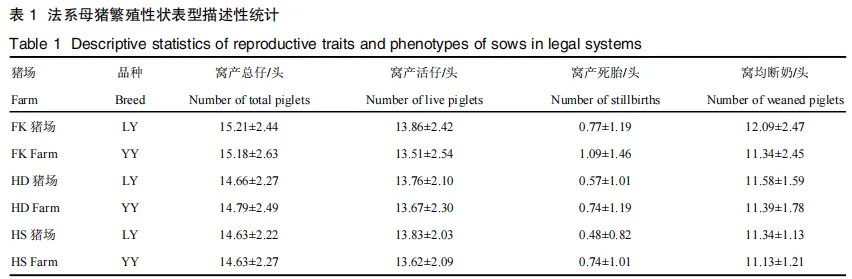
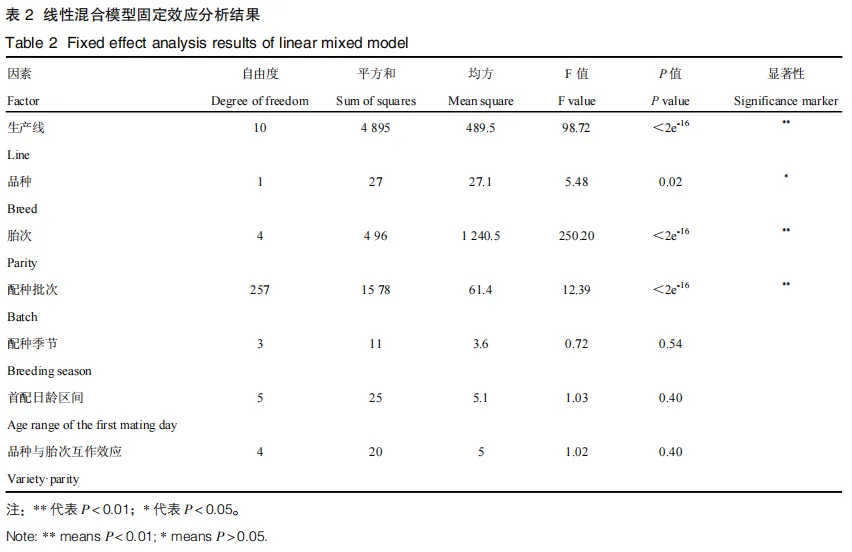
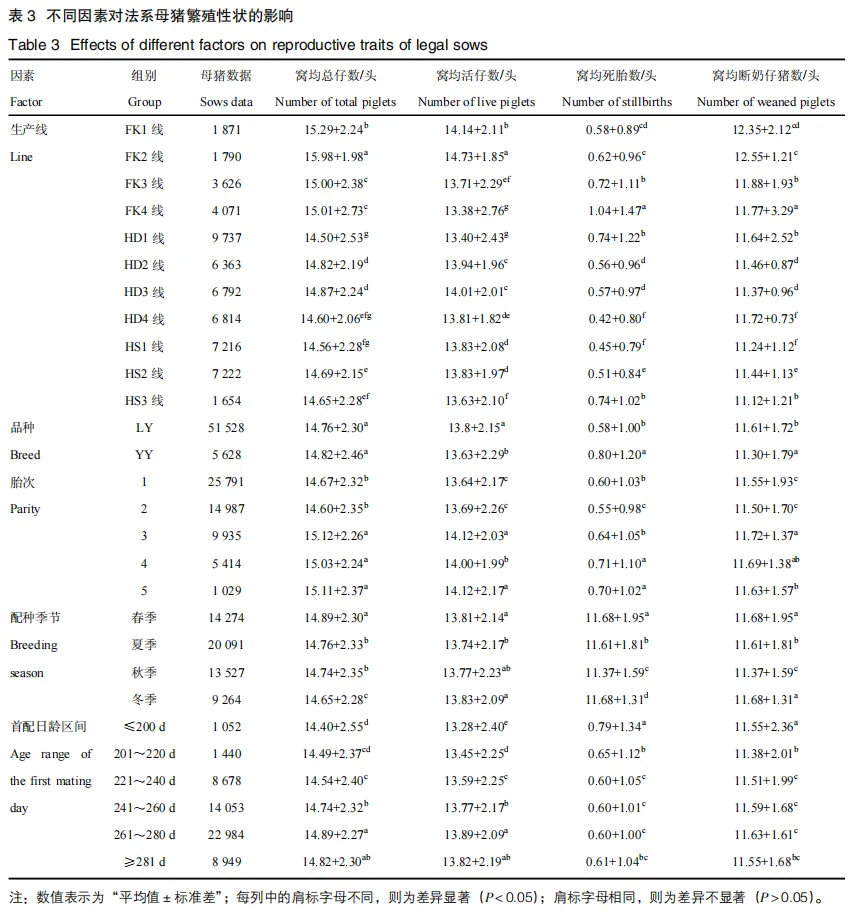
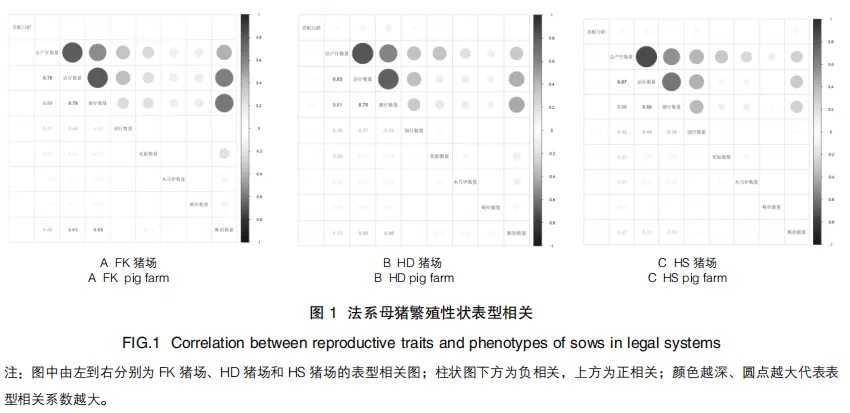
Abstract: This study aimed to investigate the effects of breed, parity, and mating season on reproductive traits of French-derived sows in multi-story pig farms. Based on data from 33 452 French-derived sows across three multi-story pig farms in South China and Southwest China, delivery records of Landrace sows (YY) and Landrace×Yorkshire crossbred sows (LY) were statistically analyzed using R4.4.2 software. A Linear Mixed Model (LMM) was applied to evaluate differences in reproductive performance across production lines, breeds, parities, and mating seasons. The results demonstrated that production line, breed, and parity were the most significant factors influencing reproductive traits (P<0.01). Compared with YY purebred sows, LY crossbred sows exhibited a 1.25% increase in average live-born piglets per litter, a 2.74% increase in average weaned piglets per litter, and a 27.5% reduction in average stillborn piglets per litter. Furthermore, sows at parity 3 demonstrated 3.07%, 3.56%, 0.6%, and 0.07% higher total born piglets, along with 3.52%, 3.14%, 0.86%, and 0% higher live-born piglets relative to parities 1, 2, 4, and 5, respectively. Regarding seasonal variations, sows farrowing in spring produced 0.88%, 1.02%, and 1.64% more total born piglets than those farrowing in summer, autumn, and winter. For first-mating gilts, those bred at 261 to 280 days of age showed superior reproductive outcomes: total born piglets were 3.4%, 2.76%, 2.41%, 1.02%, and 0.47% higher, while live-born piglets were 4.59%, 3.27%, 2.21%, 0.87%, and 0.51% higher compared to gilts bred in the ≤200 d, 201 to 220 d, 221 to 240 d, 241 to 260 d, and ≥281 d of age brackets, respectively.



 10个月宝宝每天需要喝多少奶粉?

